
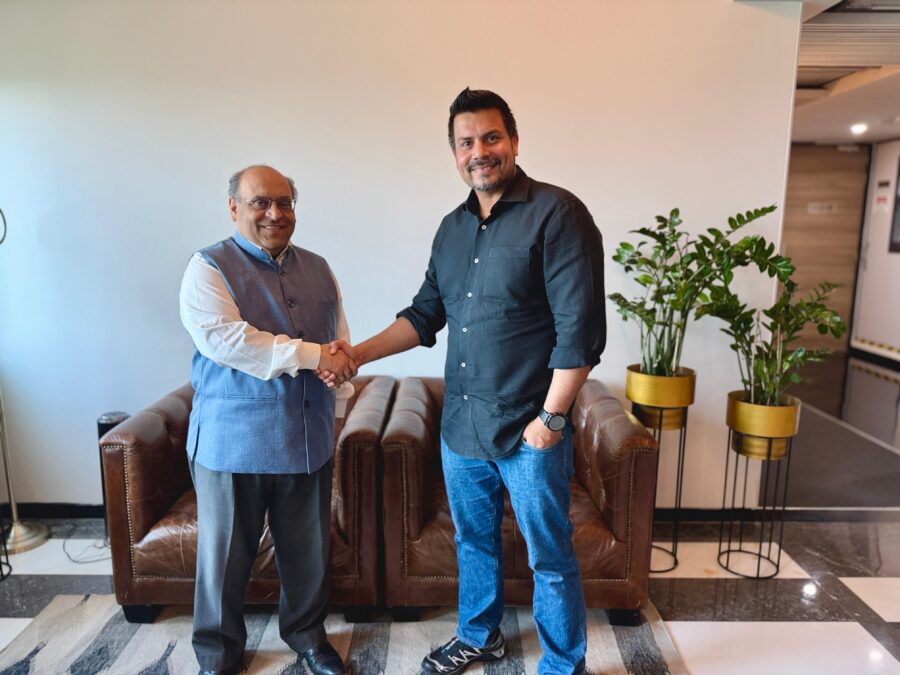
From India’s $162 billion energy import burden to the science behind well-to-wheel emissions, in an exclusive interview with Amit Chhangani, editor, Motoroids, Mr. Vikram Gulati delivers a masterclass in why sustainable mobility needs fewer ideological battles and more national clarity. Mr. Vikram Gulati is the Executive Vice Chairman of Toyota Kirloskar Motor, one of India’s most senior automotive industry voices. A long-time advocate of multi-pathway clean mobility, he has been instrumental in shaping Toyota’s India strategy across electrification, ethanol, and manufacturing localisation.
Amit Chhangani is the founder of Motoroids, India’s pioneering digital automotive publication, and Chairman of FASTER (Federation of Auto Scribes of the Electronic Realm). This conversation was recorded as an exclusive interview in April 2025.
In a wide-ranging conversation, Mr. Gulati made a passionate case for technology-agnostic, nationally-anchored automotive policy. He argued that hybrids and flex-fuel ethanol vehicles are not stopgaps but strategically pertinent solutions for India’s specific energy security and decarbonisation challenges. Any policy or incentives towards mobility should be guided only by India’s national interest and backed by science, everything else, according to him, is just a distraction.
Amit Chhangani: Toyota has long championed sustainable mobility. How does the company see its journey so far?
Mr. Vikram Gulati: Toyota’s commitment to sustainability predates the current mainstream conversation by decades. The first battery electric, the RAV4 EV, was introduced in the US in 1996. Work on hydrogen has been ongoing for decades. When pure electrics didn’t achieve customer adoption due to pricing, charging time, range anxiety, and infrastructure gaps, the hybrid emerged as the practical solution. It offered on-board charging, improving efficiency over time and eventually giving rise to plug-in hybrids, range-extended EVs, and electrified flex-fuel vehicles.
In 2015, Toyota set six global environmental challenges, three of which target net-zero carbon, not just at the tailpipe, but across manufacturing and the entire product lifecycle. The targets are zero carbon manufacturing by 2035 and a full lifecycle zero-carbon product by 2050. Toyota India’s manufacturing already runs on 100% renewable electricity, and with afforestation and efficiency measures factored in, the plant is close to carbon neutrality, well ahead of the global target.
AC: How effective are hybrids in real-world Indian conditions specifically?
VG: In controlled lab testing certified by ICAT, a strong hybrid delivers 40 to 50% better fuel efficiency than a comparable petrol vehicle. But in Indian city driving, stop-start, low-speed, high-congestion, that improvement jumps to 140 to 160%, because the vehicle runs predominantly on electric power precisely where pollution is most acute. A comparable petrol car, by contrast, is at its least efficient and most polluting in exactly those conditions. For a country still 74% dependent on coal for actual electricity generation and importing 87% of its fossil fuel requirements, the hybrid’s case is both environmental and strategic.
AC: With India’s energy import bill at $162 billion, of which $130 to $134 billion is fossil fuels, how urgent is this?
VG: Extremely urgent, and the recent geopolitical environment has made the vulnerability impossible to ignore. It’s not just about fiscal and current account deficits. There’s now a real possibility of access disruptions due to global blockades. And separately, restrictions imposed by countries controlling rare earth metals and magnets have exposed another layer of vulnerability in the EV supply chain. Battery cells for EVs, regardless of what is claimed, are still being entirely imported, and even domestic cell manufacturers are importing the anode, cathode, and electrolyte. The value and the vulnerability sit in the same place.
Toyota’s group company TCAP has localised E-Drive production in India, the fourth such plant globally and the first outside Japan and Malaysia, with a capacity of approximately 135,000 units annually and already exporting to international markets. That is genuine localisation of a critical EV component.
AC: A comprehensive well-to-wheel study once concluded that small diesel hybrids are the cleanest four-wheeler powertrain available. Yet policy doesn’t incentivise them. Is there a case for more scientific clarity?
VG: Factually, the cleanest powertrain on a well-to-wheel basis today, accounting for energy carbon intensity, is the flex-fuel strong hybrid running on 100% ethanol. Its carbon footprint is approximately 18 to 19 grams per kilometre. Battery EVs, when India’s coal-heavy generation mix is factored in, carry a significantly higher well-to-wheel carbon burden.
On diesel specifically: post-BS6, all fuels, petrol, diesel, and CNG, are held to identical pollution emission limits, irrespective of engine size. The historical stigma around diesel is legacy baggage. From a carbon standpoint, diesel is actually more efficient than petrol and carries a lower carbon footprint. Toyota’s position with the government has consistently been: policy must be rooted in science and national interest, not in assumptions about technology. Every technology should be measured against India’s actual goals: energy security, decarbonisation, pollution reduction, and manufacturing employment. Whichever technology best serves those goals deserves proportionate policy support.
AC: What is the case for flex-fuel vehicles, and how quickly can India scale them?
VG: The case is strong. Ethanol is indigenous, produced from surplus agricultural feedstock, grains and sugarcane that the government was previously subsidising just to export or store. With 600 to 800 crore litres of surplus ethanol already available, and Gen 2 production from parali, rice straw, and agricultural waste adding to supply each year, the headroom is significant.
The right approach is not to keep raising the mono-fuel blend mandate, which creates compatibility problems with older vehicles and variability issues for engine calibration depending on seasonal ethanol availability. The right approach is to introduce flex-fuel vehicles, which can run on any ethanol-petrol blend from E0 to E100. Brazil’s experience is instructive: with a mono-fuel mandate of E27, its national blending average is 55%. India, with an E20 mandate and flex-fuel vehicles in the market, could realistically average E30 within a couple of years.
All OEMs, including Toyota, which displayed the flex-fuel Hyryder and Corolla at the Bharat Mobility Expo, have the technology ready. The barrier is purely policy: CAFE treatment, ethanol pricing relative to petrol, vehicle cost implications, and pan-India fuel quality and availability. Government is actively engaged on all four fronts. Once those enablers are in place, flex-fuel models will arrive across the market quickly, because the manufacturing supply chain for FFVs is largely shared with conventional ICE vehicles.
AC: On EVs, Toyota has the eBella now, but what is the broader electric strategy?
VG: Battery electric is an important clean technology and Toyota welcomes its growing consumer adoption. The company’s approach is entirely technology-agnostic. BEV is one of several clean pathways, not a singular destination. Consumer needs vary widely, and no single technology can serve all of them. Toyota will introduce clean technologies across the spectrum as and when consumer needs and market conditions align. The multi-pathway approach, spanning hybrid, plug-in hybrid, flex-fuel, hydrogen, and BEV, reflects the belief that the task of sustainable mobility in a market of India’s scale and diversity requires every available tool.
AC: On the reported discontinuation of the Innova Crysta and an alleged successor model, any comment?
VG: Those reports are entirely speculative. There is no official word on the Crysta’s future. As a company policy, Toyota does not discuss upcoming products until launch.
AC: Final question: if you had one policy wish for the Indian automotive sector, what would it be?
VG: That Indian automotive policy be rooted solely in India’s national objectives, transparent, fair, and technology-neutral. Energy security. Decarbonisation. Pollution reduction. Manufacturing jobs. Inclusive growth. If you use those as your North Star and measure every technology and every company against those outcomes, the policy writes itself. The technology that delivers better results gets better treatment. The one that doesn’t, gets discouraged. Simple.
The BEV-versus-hybrid debate, the diesel versus petrol debate, these are distractions. They are means to an end. The end should be crystal clear. Without that clarity, we create confusion, dispersion, and a lack of direction. With it, we can achieve what the Prime Minister has set out: a developed, energy self-reliant, supply-chain-resilient India by 2047, with the benefits of growth reaching those millions who are still waiting for their share.
*This is an exclusive interview. It has been edited and condensed for clarity.