
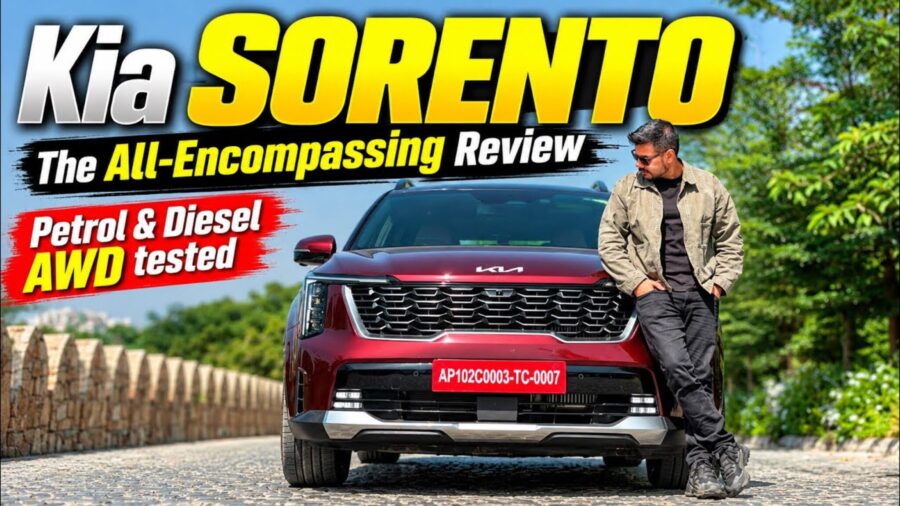
Kia Sorento has created a lot of buzz and has been a point of discussion for some time. Now that the SUV is available in India, we got the chance to spend time with both its diesel and strong-hybrid versions. The Sorento brings three-row seating, a long equipment list and two very different powertrains to the segment.
Design and road presence
The Sorento has a clean but substantial design. It measures 4,815mm in length, 1,900mm in width and 1,785mm in height, with a 2,815mm wheelbase. The SUV also gets 209mm of ground clearance for India.
Key exterior details include:
- Star Map LED DRLs
- Vertically stacked LED headlamps
- Digital Tiger Nose grille
- L-shaped rear lamps
- 19-inch alloy wheels
- Panoramic sunroof
- 235/55 R19 tyres
The tall sidewall tyres also help the SUV deal with rough roads.
Cabin and features
The cabin is one of the strongest parts of the Sorento. The dashboard gets a large curved display setup, while the materials and switchgear give it a premium feel.
Some important features include:
- 12.3-inch infotainment screen
- 12.3-inch digital instrument display
- Head-up display
- 12-speaker Bose audio system
- Ventilated front and second-row seats
- Panoramic sunroof
- 64-colour ambient lighting
- Digital IRVM
- 220V power outlet
- Kia Connect with OTA updates
- AI voice assistant
- Remote Smart Parking Assist
- Ergo-motion driver seat
The climate controls use a separate touch-sensitive panel, which can also be switched to infotainment shortcuts.
Space and practicality
The Sorento is offered with six- and seven-seat layouts. The second row is particularly comfortable, especially with the captain seats. There is good legroom, useful under-thigh support and ventilation.
The third row is easier to access than expected, but adults may not find it ideal for longer journeys. The seat is positioned low, resulting in a knees-up seating position. Children and shorter passengers should find it more suitable.
Boot space stands at 179 litres with all three rows in use and increases to 813 litres when the third row is folded.
Diesel or hybrid?
The 1.6-litre turbo-petrol strong hybrid produces a combined 230hp and 380Nm. It uses a 6-speed automatic and feels smooth in city traffic. Electric assistance makes initial responses quick, while the petrol engine becomes more noticeable when driven hard.
The 2.2-litre diesel makes 193hp and 442Nm and gets an 8-speed wet DCT. It feels better suited to highway driving, with strong torque and relaxed cruising.
Claimed efficiency figures are:
| Powertrain | FWD | AWD |
|---|---|---|
| Hybrid | 19.60kmpl | 17.70kmpl |
| Diesel | 17.66kmpl | 15.79kmpl |
Ride, handling and safety
Ride comfort is a major strength. The suspension handles broken roads well, while the Sorento stays stable at highway speeds. Steering is light, although it does not offer the same sharpness as some European rivals.
AWD versions get Snow, Mud and Sand modes. This is primarily a road-focused SUV rather than a hardcore off-roader.
Safety equipment on higher variants includes 10 airbags, a 360-degree camera, five radars, parking sensors and Level 2+ ADAS with multiple functions.
Verdict
The Sorento works well as a comfortable family SUV. The hybrid suits city use and buyers who want smooth performance, while the diesel makes more sense for regular highway travel. With strong cabin quality, useful technology, good ride comfort and a choice of six or seven seats, the Sorento makes a strong case in its price range.