
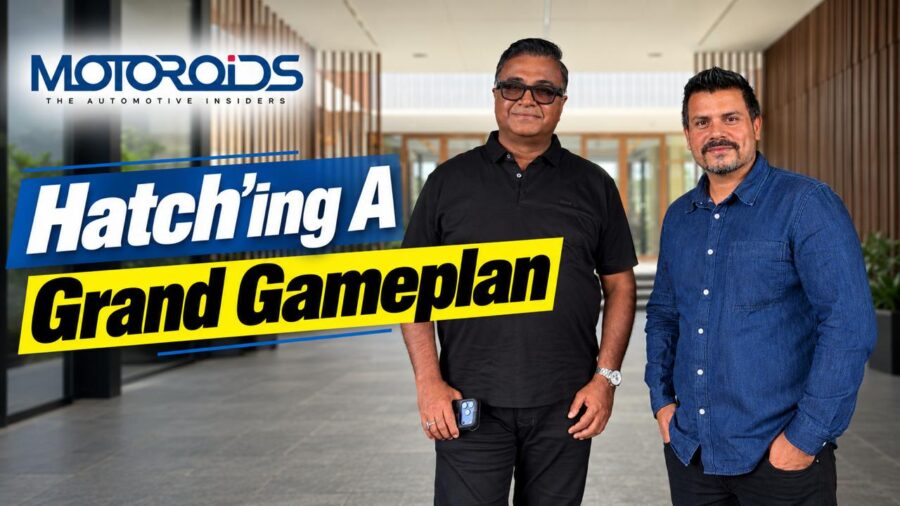
In a candid interaction, Partho Banerjee, Senior Executive Officer, Sales and Marketing at Maruti Suzuki, spoke with Amit Chhangani, Editor, Motoroids about why the Boosterjet hasn’t made it to the Baleno, how the company thinks about bookings and demand, its continuing commitment to hatchbacks even as SUVs dominate headlines, and why Maruti walked away from diesel. Edited excerpts.
On why the Boosterjet hasn’t come to the Baleno
Q: The Boosterjet engine was a real highlight on the Baleno RS. With Maruti now targeting a younger, more premium audience, wouldn’t it make sense to bring that engine back, especially as a way to turn the Baleno into a proper hot hatch?
Partho Banerjee: There’s no denying the appetite for it, and we take that feedback seriously. But for Maruti, mileage and cost of ownership remain non-negotiable. Think of them as the foundation of a multi-storey building: get that wrong, and nothing built on top of it holds up. We’ve seen brands falter because they didn’t respect that foundation.
Take the Brezza’s turbo engine. When we launched it with a 1.0-litre unit while rivals offered 1.2-litre turbos, there was plenty of scepticism. My response was simple: don’t get caught up in displacement numbers, drive the car first, then judge it. The market has since answered that question for us; the turbo has been very well received.
The same philosophy applies to the Baleno. When we decide what to bring to a car, we start with what actually matters to the customer, not with what looks good on a spec sheet. We’re using better engineering to deliver a better experience with less material, that’s not a compromise, it’s efficiency. And it saves national resources in the process.
Q: So the features you do choose to add, like ADAS and ventilated seats, come out of a deliberate reading of customer clinics rather than a checklist exercise?
Partho Banerjee: Exactly. Some people ask why we’re offering ADAS 2.0 on a car priced where the Baleno is. My answer: why should a customer have to wait until they can afford a ₹15–20 lakh car to experience that kind of safety technology?
The share of buyers who make that decision purely because of one feature may be small today, but it plays a longer game. If a friend sits in your Baleno and feels that difference, it plants something, even if he can’t yet afford the car that would otherwise give him that experience. You have to seed that relationship before you can harvest it. Not everything needs to be won today.
That’s also why I’d ask for a little credit on the engineering side. We understand engine tuning, including on CNG powertrains, better than we’re often given credit for. What matters isn’t the cylinder count on a spec sheet; it’s whether the tune suits the product. The Baleno is a premium product, not a performance car, and we’ve calibrated it for the customer who wants composure and refinement over outright zip. A younger buyer looking for a car with a bit more mischief gets a different product built with that customer in mind. You can’t ask one car to be everything to everyone; you need sharp focus on who you’re actually building it for.
On bookings, demand, and why Maruti doesn’t chase big numbers
Q: Some launches see 15,000-20,000 bookings almost overnight. How do you read into numbers like that?
Partho Banerjee: Take the Brezza. We crossed roughly 60,000 bookings, but we never made a big deal of the number publicly, and that’s deliberate.
Large booking numbers can actually work against you. If a customer hears about a two-month waiting period, the more likely reaction is to walk into a rival showroom instead. It might generate a headline, but it can quietly hurt retention. So we don’t play up booking figures, and we’re careful about how that’s communicated.
There’s also a supply-side risk: if you rack up 1.5 lakh bookings but can only deliver 1,500 cars a month, that gap becomes its own problem.
If you want a real read on the Baleno, look at consistency instead. We’ve held around 16,500 units a month recently, with about 18,000 in July, and occasional months touching 20,000–22,000. When a model nears the end of its cycle, volumes typically taper off; we manage inventory and production to avoid that dip. We could likely book more if we chose to build a waitlist, but we’d rather not manufacture that kind of artificial scarcity.
Right now, there are SUVs in the market being discounted by ₹1 lakh or more. I won’t name names, but the Baleno continues to sell close to 16,500 units without a single rupee of discount. I’ll leave it to you to draw your own conclusions about what that says about the hatchback segment.
On SUVs and Maruti’s broader product strategy
Q: Is Maruti moving away from SUVs, or scaling back on certain products?
Partho Banerjee: Not at all. We’re continuing to invest in SUVs and will keep doing so over the next five years. The segment is growing, and we acknowledge we entered it a little later than some rivals, but we’re closing that gap.
At the same time, look at what the Baleno is achieving without discounts, against SUVs doing similar volumes with heavy incentives, and those numbers still get celebrated. That’s a question worth asking.
Q: On a related note, Maruti still favours physical buttons for core functions even as much of the industry pushes everything onto touchscreens. That seems like a deliberate read of what customers actually want.
Partho Banerjee: That comes from experience: customer clinics, structured feedback, understanding real-world usage. It’s part of why the Baleno continues to sell in the numbers it does. When someone asks me what hatchback to buy, I genuinely struggle to point them anywhere else in the segment. It remains one of the most complete products in its class, and that comes back to focusing on what’s essential rather than what’s flashy.
On hatchbacks versus SUVs, and why India still needs both
Partho Banerjee: There’s a simple principle here: if a job can be done with a precision tool, you don’t reach for a bigger one. SUVs have become fashionable, and there’s nothing wrong with that, we compete there too. But not every customer needs to be in that space, and that’s fine. There’s a market for every product.
Q: You are always confident about small cars. What’s the reasoning behind that conviction?
Partho Banerjee: It isn’t just optimism, it follows a pattern seen in developed markets. Motorisation there has largely progressed from two-wheelers to four-wheelers. Japan, for instance, no longer has the scale of two-wheeler ownership it once did; that shifted as car ownership grew. India is on a similar trajectory, but that only works if new buyers keep entering from the bottom of the market, not if existing owners simply trade up from a ₹10 lakh car to a ₹15 lakh one and then a ₹20 lakh one.
I started my own career with the Maruti 800. My son, with a stronger financial starting point than I had, may well start with something like a Brezza instead of an Alto or a WagonR, and that’s fine. If that first car gives him a good set of features, he carries that experience forward, and it can build long-term brand loyalty for when he moves to his next car in a few years. A customer’s wallet shouldn’t determine whether they get access to good features.
An SUV makes sense for buyers who prioritise space and seating position, and that’s a valid choice. But for city driving, a well-built hatchback remains hard to beat.
On safety
Q: With testing protocols evolving, does that change how you approach product development?
Partho Banerjee: Public perception should follow the regulations and the underlying engineering, not the other way round. My focus stays on the product, which is why we build in the safety features we believe the product genuinely needs. The technical specifics of the newer testing protocols sit more with our engineering team, who’d be better placed to go into that detail.
On CNG and automatic transmissions
Q: One suggestion we keep hearing from customers is an AMT transmission option on your CNG models. Is that something Maruti would consider?
Partho Banerjee: That’s a fair suggestion, and we’ll certainly look into it. Much as we did with our turbo-petrol line-up, we’ll keep evaluating what genuinely benefits the customer.
On diesel
Q: Maruti’s diesel engines were well regarded before the brand stepped away from the segment. With ongoing conversations around ethanol and continued customer interest in diesel, has that decision been reconsidered?
Partho Banerjee: Not at all, we remain confident it was the right call. We’ve made forward-looking decisions before that took time to be understood; when we introduced our CNG strategy, there was similar scepticism about the timing, and the benefits are now widely recognised.
We had a clear view of where diesel was headed when we exited the segment, and that trajectory hasn’t changed. Diesel’s share of the market is currently around 16–17% and continuing to decline gradually. We’d rather commit our resources to where the market is going than hold a position in a segment that’s structurally shrinking.
Interview conducted on September 6. Responses have been lightly edited for clarity and length.