
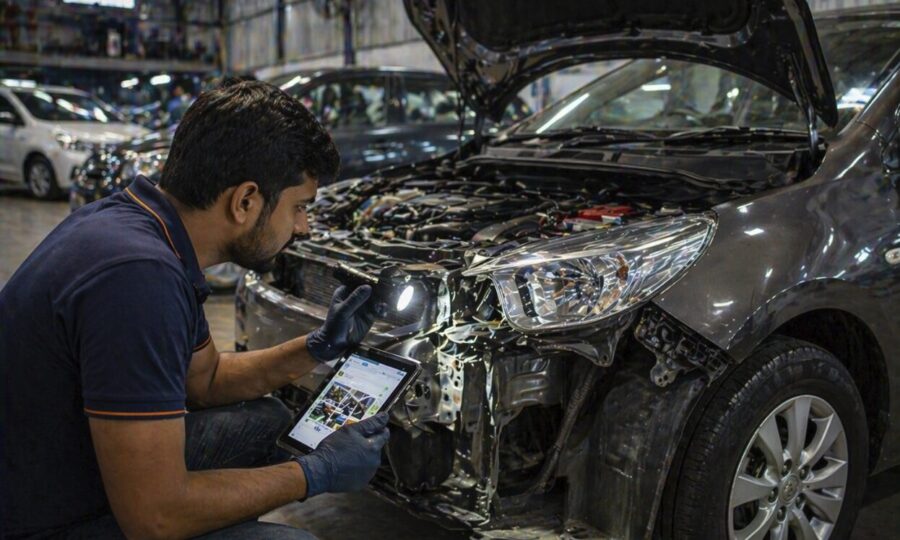
The Indian used car market is on a remarkable growth path. Valued at approximately USD 36 billion in 2025, it is projected to nearly double over the next several years. More Indians than ever are choosing pre-owned cars as a practical alternative to new vehicles. But with this growth comes a troubling reality. Inspection data from Cars24 reveals that 25% of used cars inspected have an undisclosed accidental history. That means one out of every four vehicles has been in an accident the seller chose not to mention.
These are not always minor scrapes. Many involve structural damage, chassis repairs, airbag deployments or major panel replacements that directly affect vehicle safety and resale value. In a market that remains largely unorganised, with local dealers accounting for over 70% of transactions, the burden of uncovering these facts falls entirely on the buyer.
The Problem Goes Deeper Than Accident History
Accidental history is only one piece of the puzzle. Cars24’s data shows that nearly 45% of vehicles have tyre health concerns, often pointing to deeper alignment or suspension problems. Suspension issues appear in 30% of inspections. Engine problems show up in 25% of cases, AC failures are equally common at 25%, and brake issues are found in 15%. About 20% of used cars have tampered odometers, meaning a car showing 30,000 kilometres might actually have covered 80,000 or more. Every system in that vehicle has aged far more than the buyer is led to believe.
Why Traditional Inspections Miss Accident Damage
Many buyers take the vehicle to a trusted local mechanic for a once-over. While mechanics are skilled at spotting obvious engine sounds or leaks, detecting professionally repaired accident damage requires different tools and training. Modern body shops have become extremely good at concealing repairs. A skilled repaint can make a heavily damaged panel look factory-fresh. Chassis straightening can restore visual appearance without fully restoring structural integrity. Without a paint thickness gauge, OBD scanner and trained expertise, these signs go undetected. This is precisely why professional pre-delivery inspections have become essential.
How Different PDI Providers Approach This
Several PDI providers have emerged in India, each with a distinct approach.
Zekardo brings technical rigour through their proprietary Claruz software, which assesses over 3,700 anomaly detection scenarios. They are particularly strong at identifying cosmetic and structural irregularities like paint inconsistencies and panel gaps. They operate with no dealer tie-ups and follow a ‘Pay After PDI’ model. Their focus, however, is primarily on new car PDI, and their presence is limited to select metros such as Delhi NCR, Mumbai and Bangalore.
CarCID offers a structured framework with 300+ checkpoints, including accident history assessments. They check for repainting, chassis rework, replaced panels and glass components. Their tiered pricing based on engine capacity makes inspections accessible across budgets. They also provide service history verification from authorised centres and AI-powered valuations based on over 100,000 data points.
Cars24’s CarTruth PDI takes a layered approach that combines physical inspection with document and legal verification. Their 300-point assessment by certified automotive engineers covers paint thickness, OBD/ECU scanning, engine compression, suspension and detailed exterior and interior review. Alongside this, CarTruth verifies ownership through VAHAN/RTO databases, checks loan status with banks and NBFCs, reviews traffic challans and court cases, and pulls up accident, insurance and service history. This means that even if a repair job fools a paint gauge, insurance claim records will likely tell a different story.
What further distinguishes Cars24 is the Rs 50,000 Moneyback Promise. If CarTruth misses a critical finding such as accidental history, odometer rollback over 2%, flood damage, theft or blacklist status, wrong ownership count, or false repaint claims, the buyer is financially compensated. With over 1 crore inspections completed and 1,500+ professionals across 220+ cities, the consistency and reach of the service is backed by scale that smaller providers have not yet matched.
The Real Cost of Buying an Accident-Damaged Car
A vehicle with structural damage may have compromised crumple zones, meaning it will not protect occupants as well in a future collision. Misaligned frames cause uneven tyre wear, pulling during braking and instability at highway speeds. On the financial side, a car with documented accident history can lose 15 to 30% of its resale value. If you paid full price for such a car, you have already overpaid, and the next buyer’s inspection will reveal what yours did not.
What Smart Buyers Should Demand
In a market where one in four used cars carries hidden accident damage, buying without a professional inspection is a gamble with your money and safety. A surface-level mechanical check may catch visible damage, but it will not reveal a clean repaint hiding a major collision. A thorough inspection should combine physical evaluation with document verification, insurance history review and digital reporting with photographic evidence. If the provider also offers financial accountability for missed findings, that provides genuine assurance of inspection quality. In a market growing at 14 to 15% annually and still largely unregulated, PDI is the single most effective tool a buyer has to separate a smart purchase from an expensive mistake.