
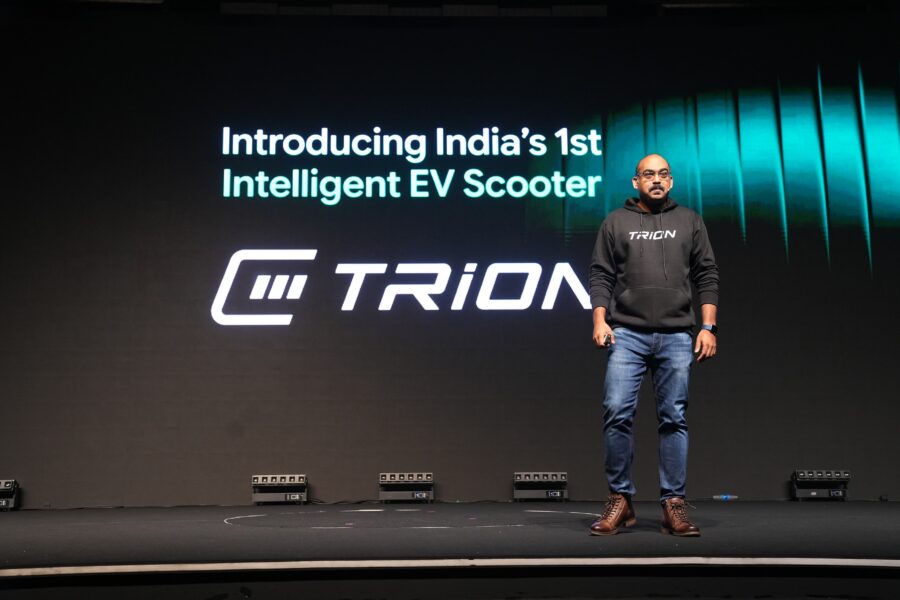
One-on-One with Sanjeev P, Founder & CEO, E3 Electric.AI
The Indian electric two-wheeler market has grown rapidly over the past few years. But while the number of products on sale has increased, one question continues to remain important for buyers: what will ownership actually be like after the purchase? Battery life, charging, range, service and reliability are all part of that equation. E3 Electric.AI says it is attempting to address these concerns through a combination of modular hardware and artificial intelligence.
The company has developed the Trion scooter platform around what it calls the Euclidean Three-Space formula, with a common architecture intended to support multiple variants. It also uses predictive analytics to monitor vehicle health and rider behaviour, with the aim of identifying potential issues before they become failures.
We recently spoke to Sanjeev P, Founder and CEO of E3 Electric.AI, about the thinking behind the company, its approach to EV technology, the Trion’s engineering, real-world range, charging strategy and its plans for scaling the business.
Here is what he had to say.
What Problem Is E3 Trying To Solve?
Vipul: Let’s start with what you saw, what was the problem you identified in the Indian EV market that convinced you something like E3 should exist?
Sanjeev: I’ve been in the EV industry for over seven years and have seen at least half a million vehicles across 100+ markets. The data is very clear. Whether you look at Google search trends — people searching for electric scooters versus ICE scooters — it’s 110 to 100. Awareness is already there. People know why they need electric, but still only 7% actually buy. The number of EV scooter choices versus ICE is also about 1:10. But the most important problem — and I mentioned this during our launch as well — is ownership confidence.
The first question buyers ask is: what’s going to happen to my battery? Will it last? If it doesn’t, what will the replacement cost be? The second concern is charging — where do I charge, and how?
I recently posted about an impromptu trip I took with two of our women colleagues — a software developer and an analyst. We set out at 5 a.m. on a Saturday to Hogenakkal and covered 200 kilometres including mountain terrain. Because our battery is easily swappable, we carried an extra and didn’t have to worry about charging at all. That’s exactly the kind of ownership confidence I’m talking about.
And it’s not just about the battery — it’s also about safety. These were two young women, 5’1”, riding challenging terrain for the first time. Every design choice we made — the 14-inch wheels, the tri-axis modular frame — was made to solve for range anxiety, safety, and service.
On service specifically, I noticed that irrespective of which company you look at, service is reactive — because when electronics and parts fail, you’re scrambling to source components. The only way to solve this is by building an intelligent layer that predicts failures before they happen so the right parts can be prepared in advance. That’s why I developed the Euclidean Three-Space formula — a modular platform where 70% of parts are common across four different product variants, each serving a different customer type with different performance and range requirements. I chose AI to solve the intelligent problems, and the human-centric approach guided everything else — safety first, then comfort, then trust.
Why AI For An Electric Scooter?
Vipul: Why AI? The company name itself has AI in it. What can AI do for EVs that conventional software cannot?
Sanjeev: Conventional software connects electronic components and tells you what’s happening with the scooter in real time — fault codes, ignition status, location tracking, and so on. What our technology does is fundamentally different: it’s predictive.
We collect data via IoT Core, send it to our cloud, and run machine learning algorithms that detect anomalies before they become failures. Take range as an example. You might ride in heavy traffic in the morning, on a highway in the afternoon, and with a pillion in the evening. Those are three very different ride situations, and traditional vehicle software cannot account for all of them. Our software can — and that’s the intelligent layer.
A real-world example: one of our test riders had a habit of holding the brake while pushing the accelerator. That rider was getting 20 kilometres less range than another rider on the same vehicle. Our AI can now alert her — telling her she’s holding the brake 48% of the time and that if she continues, she’ll lose 20 kilometres of range. That’s predictive rider behaviour analytics in action.
The second application is predictive servicing. By observing riding behaviour and the stress the system is under, the AI tells our command centre which parts to keep ready for each vehicle, reducing downtime significantly. Beyond that, we have a smart route planner that maps charging stations along your route and, based on your riding history and behaviour, tells you whether you’ll cover, say, 50 kilometres on 50% charge — or more, if your riding style is efficient. These are the kinds of intelligence we bring.
Why A Hub Motor And The Roto-Ring Architecture?
Vipul: Let’s talk about the motor. Why did you choose a hub motor — specifically the Roto-Ring architecture for the E3? Is it a patented tech?
Sanjeev: When we decided to go electric, we were very clear: we needed to reduce the number of mechanical failure points — belt-driven systems, shafts, gear systems, and so on. The focus had to shift to electronics and software.
The Roto Ring architecture is a clean, well-engineered design that allows different motor powertrains to fit within a 14-inch wheel system. Whether it’s an L1 motor running up to 65–70 km/h or a higher-powered motor running up to 80 km/h, both can go on the same platform. It also makes servicing far simpler — you can remove the motor with basic fasteners, so even a local mechanic can handle it in the event of a running-gear issue. No need to go back to the company. And of course, it ensures forward compatibility and scalability.
And yes — it’s our own patented technology. We developed it in-house. When you ride the scooter, you’ll feel the stability it delivers firsthand. That’s ultimately why we could take it on an impromptu mountain ride with confidence.
What Is The Real-World Range?
Vipul: What real-world range have you been able to achieve during testing — not IDC numbers, but actual figures?
Sanjeev: It genuinely depends on the terrain and the rider. On the C1X, a rider weighing around 90–95 kg achieved approximately 102 km. A rider with less optimal behaviour — holding the brake frequently, for instance — might get anywhere from 105 to 111 km under different conditions. The variation is exactly why we’re building Rider Behaviour Analytics — to help riders understand their habits and get the best out of the vehicle. The C2 similarly delivers around 100–110 km in real-world conditions.
The Tri-Axis Frame And Why It Matters
Vipul: You’ve touched on it briefly — can you explain the Tri-Axis frame in more detail? What does it mean for the end customer?
Sanjeev: Everything on a scooter — modularity, robustness, rideability — ultimately rests on the frame. Our Tri-Axis frame was designed to be strong, modular, and scalable. It already underpins three different scooter variants, and a utility variant is also in the works on the same platform.
One of the key engineering challenges was achieving the right wheelbase — 1,275 mm — within a 14-inch wheel system. A longer wheelbase makes city riding cumbersome; too short and you compromise stability. We optimised for both. The result is a vehicle that feels extremely planted on poor road surfaces. I recently posted a video of a ride through some genuinely terrible roads in Bengaluru’s Electronics City area — the kind with ruts, potholes, and heat damage — and you can see how stable and grounded the scooter is.
The second benefit is manoeuvrability in city conditions. The wheelbase gives you the ability to navigate tight roads and zip through traffic comfortably. Third is the ergonomics — I rode 220–230 kilometres from 4 a.m. to 7 p.m. with no back pain. That’s not something I’d claim lightly.
Could The Platform Spawn An Electric Motorcycle?
Vipul: Could this frame spawn an electric motorcycle?
Sanjeev: Not a motorcycle — the architecture is quite different. But it can absolutely support utility variants. Think storage-focused applications: rural use cases where you need to shuttle produce from a farm, business users in smaller markets, and so on. The large 14-inch wheels, the stability and the strength of the frame make it well-suited for those categories. There’s a lot of exciting territory to explore there.
Balancing Battery Weight And Ride Quality
Vipul: One thing I’ve observed with electric scooters is that the added battery weight often results in stiffer suspension setups that compromise ride quality. How have you addressed this?
Sanjeev: We went with dual-rated suspensions — K1 and K2 — both front and rear. This handles the load variation between a single rider and a pillion effectively. Several new scooter launches are using monoshock setups, but we chose dual shocks because they handle exciting forces and rear load far better.
More importantly, our battery placement isn’t in the floorboard — it’s positioned at the centre of gravity. This gives the scooter excellent balance and eliminates the typical top-heavy or front-heavy feel you get when battery weight isn’t managed carefully. There’s no perceptible stress from battery weight while riding. The suspension work took significant effort, but the outcome is genuinely comfortable.
Scaling To 90 Markets Without Compromising Service
Vipul: You’ve talked about targeting 90 markets. As you scale, how will you ensure service quality doesn’t slip?
Sanjeev: We said 90 as a vision — we’re starting in Bengaluru and scaling responsibly, step by step. We already have over 140 dealership applications across 74 markets, but we’re being very deliberate about which ones we activate and when. We’ve had people travel from Odisha, Delhi, Andhra Pradesh to our experience centre in Bengaluru requesting dealerships — and we’re taking our time with each one.
The second part of the answer is the intelligent command centre architecture. Because our AI monitors rider behaviour and vehicle health, we can anticipate parts requirements before a single customer faces downtime. That’s how we scale service without it becoming reactive. Ownership experience is not just about the product — service is a critical part of it, and we’re paying close attention.
Lessons From TVS And Designing Without Benchmarking Rivals
Vipul: You come from TVS. What learnings from your past have shaped the E3?
Sanjeev: Every company I’ve worked at has reinforced the same thing — the customer is king. But I want to be clear: E3 did not design the Trion by benchmarking competitor specs or trying to build a better version of an existing product. The Trion was conceived entirely around customer problems, ground up.
Even the design — you can look at it and not say it resembles anything else on the market. Two years ago, I sat with our design team and gave them one clear instruction: do not show me any existing scooter and tell me you’ll do better. No reference panels, no competitor lighting, nothing. We looked at where design is moving globally — the shift towards geometric aesthetics — but calibrated it for India. Indians aren’t ready for a full Cybertruck-level geometric leap just yet, but you can move them forward. We drew inspiration from the Mars Rover — the edgy character, the large wheels, the lamp design. Our projector headlamps in particular are unlike anything else out there. I’d encourage people to look at the LinkedIn post I wrote about it.
E3 Trion Vs Established EV Players
Vipul: If I’m a customer looking at an E3 versus an Ather, a TVS, or a Bajaj — why should I choose E3?
Sanjeev: The first filter for any scooter purchase is design — and that’s a clear tick for us. Once that’s settled, the next question is always range. Given the powertrain choices we’ve made — optimised specifically for range performance — we’re best in class on real-world range. Once those two boxes are checked, it comes down to: do you want a better product, or do you want a better ownership experience? We’re offering both. Come experience it, and if it resonates, you’ll know.
Who Is The E3 Trion For?
Vipul: Who exactly is your target customer?
Sanjeev: We see three key cohorts that make up roughly 80% of scooter buyers. First, young riders — college goers and early office professionals. Second, family riders. Third, business and delivery users. We have a product for each: the C1 for city commuters — portable battery, 90 km real-world range, multiple charging options; the C1X for range-optimised riding; and the C2 for full performance. Each is built on the same modular platform.
An Open Approach To Charging
Vipul: What’s your charging strategy — proprietary network or third-party partnerships?
Sanjeev: Think of it like the car industry — you can’t sell cars and then build your own petrol pumps. You need to work within the existing ecosystem. We chose the open standard — specifically Type 7 — which is gaining significant traction and is supported by several players under the LEAF umbrella. Implementing this required substantial engineering, including full compliance with the public charging protocol OCPP 1.6. So the vehicle is compatible with any Type 7 charger on the public network.
Beyond that, we support OCPP and OCPI, so any smart plug on any public charging network can be used — though at slower speeds in an emergency. We also provide an off-board charger that riders can carry and use anywhere. And for those who prefer it, the battery can be removed and charged at home. We didn’t want to limit users to one approach — multiple options was always the goal. The charging architecture runs at 51.2 volts.
Production Capacity And Delivery Timeline
Vipul: What’s your current production capacity, and when are deliveries beginning?
Sanjeev: We announced during the launch that we’d begin deliveries by end of this month — starting with Bengaluru. Production capacity isn’t the constraint. We can comfortably reach 5,000–10,000 vehicles per month, and we can scale further if demand requires it. What I’m focused on is execution — delivering the product, delivering the service, and delivering on the intelligent experience promises. We’re not chasing volume numbers. For me, the success metric is NPS and customer satisfaction.
What Could Be The Biggest Risk For E3?
Vipul: Do you foresee any risks to the Trion brand in the coming years?
Sanjeev: The risk, like in any business, is execution. We’ve built a strong product and a scalable platform. The challenge is delivering consistent quality at scale, maintaining service standards as we grow, and ensuring the intelligent features perform as promised. That’s the risk — and equally, the opportunity. We’ve set up the architecture well. Now it’s about execution.
Building A Consistent Dealership Experience
Vipul: Dealerships will be the face of the company on the ground. How are you ensuring a consistent customer experience at the dealership level?
Sanjeev: Our experience centre in Bengaluru is a good reference point. From the moment you walk in, the space is self-explanatory. There’s a full display of the Tri-Axis frame, a live demo of Port 3, and an AI experience zone where you can scan a QR code and see an AR model of the vehicle right on the showroom floor. You can place a suitcase in the storage area to see how it fits. There’s a VR experience as well.
The idea was to make everything experiential and self-guided — no danglers, no leaflets, no dependence on a sales executive to explain every feature. By the time a customer approaches the sales team, they’ve already understood the product and are asking targeted questions.
Vipul: I’m assuming the experience centre is like a flagship dealership for everyone?
Sanjeev: We’ve also standardised this across formats: the E3 Experience Centre (3S), E3 Space (2S), and E3 Hub (1S) for smaller towns. Whether you walk into a showroom in Bengaluru or Nashik, the experience will feel consistent.
What Should Give Buyers Confidence In E3?
Vipul: Last question — if I give you ₹1.5 lakh and say I want to own this scooter for five to seven years, what’s the one reason you’d give me to trust E3?
Sanjeev: You will not have a surprise breakdown. You’ll always know what’s happening with your vehicle. You’ll have a genuinely good ownership experience — and if anything does go wrong, you’ll know exactly who to call and they’ll be there for you. That’s what I set out to build, and that’s what I measure success by.
Vipul: Looking forward to riding the Trion soon — it’s clearly a thoughtfully built product. None of the panel gaps or half-baked finish issues we often see at EV launches. Best of luck. Looking forward to the ride.
Sanjeev: Thank you, Vipul. It’s simple, relevant technology — not overcomplicated, just genuinely useful. I often reference UPI as an analogy — ingenious in its simplicity, yet remarkably powerful. That’s what we’ve aimed for.