
Tata Motors has crossed a major milestone in India’s electric vehicle journey. Over 2.5 lakh Tata electric cars are now on Indian roads. This moment confirms quietly one thing. Electric mobility in India is no more new or experimental. It is something that has become part of everyday life.
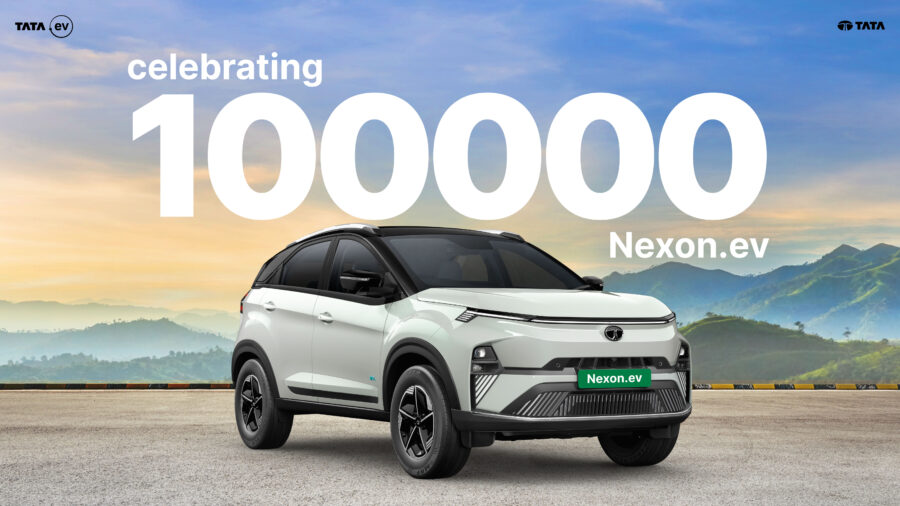
Tata did not arrive here overnight. It started back in 2018, and things began to really pick up once the Nexon EV came along in 2020. That one model changed the way the Indian buyers looked at electric cars. Today, the Nexon EV has sold 1 lakhs cars on its own, which makes it the first electric car in India to achieve this feat.
As of now, Tata holds nearly two-thirds of the Indian EV market. Around 66 per cent of all electric passenger vehicles sold till now belong to Tata. This leadership comes from offering electric cars through price points and body styles, rather than just focusing on one segment.
The present Tata EV Lineup includes models such as Tiago EV, Punch EV, Nexon EV, Curvv EV and Harrier EV. There is also XPRES T EV for fleet buyers. Together these cars make electric mobility accessible to a wide range of customers.
Some real-world usage insights show how deeply EVs have settled into daily life.
- Tata EV owners spread across over 1000 towns and cities
- 84 percent of owners have their EV as their primary car
- Over 1/4 buyers are first-time car buyers
- Average driving per year is approximately 20,000 km
- Several owners have already crossed 1 lakh km
- Half of the users have made trips of more than 500km
In all, Tata EVs have travelled almost 12 billion kilometres. This has helped to save around 1.7 million tonnes of carbon emissions and around 800 million litres of fuel.
Charging support has played a big role in this journey. Tata EV users today have access to more than 2 lakh charging points including home, community and public chargers. There are already 100 such Mega Charging hubs across major routes with fast charging speeds of over 120 kW. Tata is also planning to expand its charging network to 4 lakh points by 2027, including over 30,000 public fast chargers, and aims to reach 10 lakh points with 1 lakh public chargers by 2030 through its Open Collaboration framework.
Service and localisation are also high focus areas.
- Around 1500 EV service bays throughout India
- More than 5,000 trained EV technicians
- Over 50 per cent local content in Tata EVs
- Battery packs and systems developed in Tata Group
- Tata also supports second-life battery refurbishment and energy storage to enable a circular economy
Looking into the future, Tata is bracing itself for its next phase of growth. New electric models such as the Sierra EV, a revamped Punch EV and the Avinya range are coming from 2026. By 2030, Tata intends to have several new EV nameplates, including five completely new models, along with routine updates across its portfolio. Tata is also sourcing locally produced high-voltage battery cells from Agrata’s upcoming gigafactory in Sanand to strengthen India-first technology and EV self-sufficiency.
In simple words, Tata’s EV journey is no longer about proving a point. It is about scale, trust and everyday usability. Electric cars are not the future any more for Tata. They are already the present.