
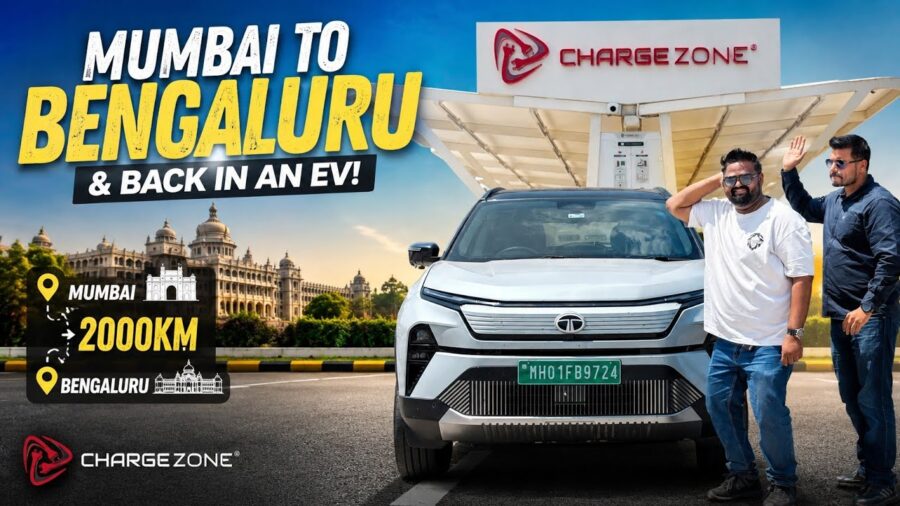
There is one question that still comes up whenever we talk about taking an electric car on a long road trip. What happens when the battery gets low and there is no charger nearby? We wanted to find out for ourselves, so we took the Tata Harrier.ev on a roughly 2,000km drive between Mumbai and Bengaluru. The trip gave us a good look at how easy long distance EV travel has become and where you still need to plan ahead.
The Road Trip
Driving an EV on highways is quite different from using one around town. Traffic, speed, weather and road conditions all affect the battery.
During our drive, we noticed that highway speeds can use more energy than city driving. In city traffic, regenerative braking helps the car recover some energy. Hot weather can also affect the range, with high temperatures having the potential to reduce it by around 10 to 15 per cent.
The Harrier.ev handled the long drive well. The bigger question was not the car itself but the charging stops.
Planning The Stops
This is where the Chargezone network became important for us. The Chargezone app helped us check chargers along the route and plan where to stop.
Some useful features include:
- Finding charging stations on the route
- Checking charger availability
- Pre booking a charging slot
- Using an RFID card for charging
- Accessing chargers near hotels and restaurants
- Checking charging details through the app
Having a restaurant or hotel close to a charger also makes a big difference. Instead of sitting inside the car and waiting, we could use the charging break for food or rest.
How Much Charging Do You Need?
One thing we noticed is that there is little reason to wait for the battery to reach 100 per cent at every stop. Keeping the battery roughly between 20 and 80 per cent can make road trips easier because the car can charge faster in that range.
This also makes it easier to plan shorter stops instead of spending a long time at one charger.
The Chargezone Experience
We also tried the Chargezone RFID system. It can be useful when mobile connectivity is not perfect and gives another way to start a charging session.
The Auto Charge feature was another interesting part of the experience. Once it is set up, the charging process becomes much simpler. You plug in and the system can recognise the vehicle without needing to use the app every time.
We also checked out the Chargezone Mega Charging Hub, which can offer charging speeds of up to 120kW.
The Cost Of The Trip
Running costs were another big part of this road trip. Charging an EV can be much cheaper than filling a diesel or petrol vehicle, especially over a distance of around 2,000km.
During the journey, we also looked at the savings on a Mumbai Goa section. The difference was quite noticeable, with the EV costing less than half of what a diesel vehicle would cost for the same distance in the example we discussed.
Maharashtra also offers toll benefits for electric vehicles on certain routes, which can further reduce the cost of travelling by EV.
A Small Thing That Matters
There is also one basic rule that every EV owner needs to follow at public chargers. Once the car has finished charging, move it.
It sounds obvious but a charger can only help another driver if it is free. Good charging habits become more important as the number of electric cars on Indian roads grows.
What We Learnt
After covering around 2,000km in the Harrier.ev, our biggest takeaway was simple. A long EV road trip is possible in India today.
But it needs a little planning.
- Check the charging points before leaving
- Keep enough battery for the next charger
- Use the app to check availability
- Avoid waiting for 100 per cent unless needed
- Take advantage of charging breaks
- Keep an RFID option as a backup
- Move the car after charging
- Watch your speed on long highway runs
- Keep weather conditions in mind
- Plan the return journey too
Final Verdict
The Mumbai Bengaluru Mumbai run showed us that range anxiety is not as big a problem as it once was. The Tata Harrier.ev was capable of handling the distance and the Chargezone network made finding and using chargers much easier. With proper planning and reliable charging support, a 2,000km EV road trip can be a practical and comfortable experience.