
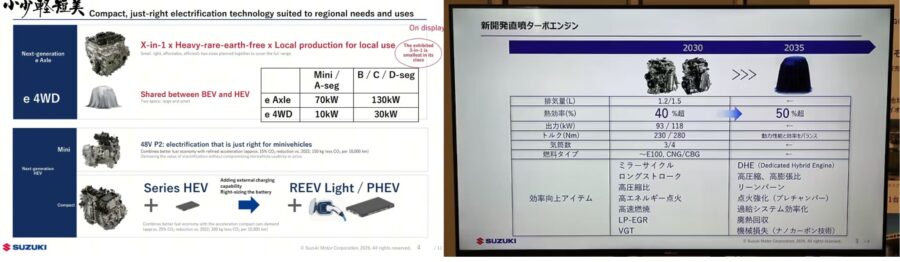
Suzuki’s engine plans are getting wider. After announcing its new direct-injection turbocharged (DITC) engine, Suzuki has outlined a versatile range of next-generation hybrid powertrains, including a compact 48V setup, a series hybrid, and a plug-in range extender (REEV). Additionally, the company has showcased a larger 1.5-litre turbo petrol engine designed for its bigger vehicle segments.
This new technology roadmap was officially presented at Suzuki’s Technology Strategy Briefing 2026 in Japan. While several of these advanced powertrains are highly relevant to future Maruti Suzuki models, specific applications for the Indian market have not yet been confirmed.
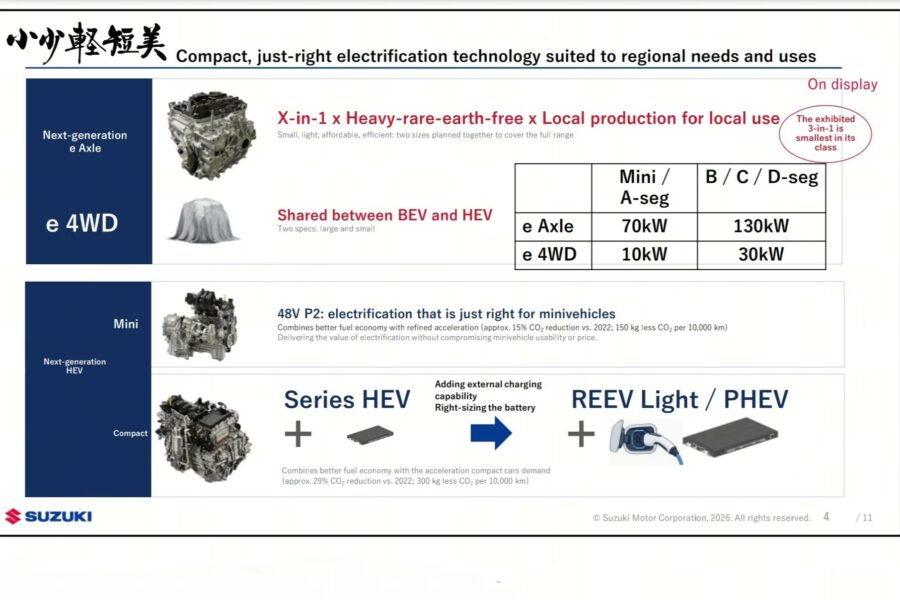
New REEV system gets external charging
Suzuki’s “REEV Light” operates on a series hybrid layout, where the electric motor directly drives the wheels while the petrol engine acts as an onboard generator to produce electricity.
By integrating external plug-in charging capabilities and scalability for different battery sizes, the system allows the vehicle to run on pure electricity for shorter daily commutes, while the petrol engine eliminates range anxiety on longer trips. Suzuki has not yet specified the exact vehicle models or engine pairings for this REEV Light setup.
Its compact-car series hybrid uses the following setup:
| Component | Specification |
|---|---|
| Petrol engine | 1.2L Z12E |
| Engine output | 60kW / 82PS |
| Engine torque | 108Nm |
| Generator | 61kW |
| Traction motor | 65kW |
| Battery | 0.6kWh |
| CO₂ reduction | About 29% |
Suzuki estimates around 29 percent lower CO₂ emissions for the compact-car series hybrid compared with its 2022 reference. The company has not shared the battery size or electric-only range of the REEV Light.
A small 48V hybrid is also planned
Suzuki is also working on a 48V P2 hybrid for kei cars. It combines a 660cc engine with a 10kW motor-generator and a 0.4kWh battery.
The setup is designed to improve fuel economy and acceleration while keeping the system compact. Suzuki estimates around 15 percent lower CO₂ emissions compared with its stated 2022 reference.
For India, cars in the Alto and S-Presso size range show where this type of technology could potentially fit.
New 1.5-litre turbo engine
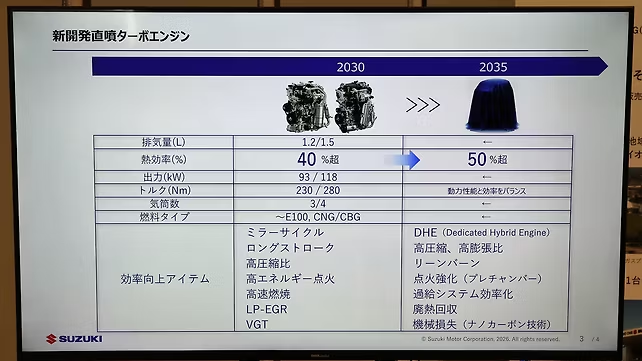
Alongside the hybrid systems, Suzuki is developing a 1.5-litre four-cylinder direct-injection turbo petrol engine.
- Power: 118kW, or around 160PS
- Torque: 280Nm
- Configuration: Four-cylinder turbo petrol
- Fuel options: E100, CNG and CBG
The engine is being developed for larger vehicles, with D-segment applications mentioned in the technology roadmap. A future Maruti SUV in the Grand Vitara size category could be one possible application, although Suzuki has not confirmed any model.
Suzuki is also developing a 1.2-litre three-cylinder turbo engine with 125bhp and 230Nm.
More power and better efficiency
Furthermore, Suzuki is developing a separate 1.2-litre turbocharged series-parallel plug-in hybrid system. It has a combined output of around 130kW, which is about 174bhp. The system can use both the petrol engine and electric motor depending on driving conditions.
Suzuki is working on improving engine efficiency. Its roadmap targets more than 40 percent thermal efficiency by around 2030, with the figure expected to cross 50 percent by 2035.
The company is developing engines that can work with E100, CNG and CBG. Suzuki is targeting weight savings of around 100kg through its future lightweight vehicle development.
What this means for Maruti Suzuki
Suzuki’s roadmap covers several powertrain types rather than one single hybrid system. Small cars could use simpler 48V technology, while compact models may get series hybrids and REEV systems. Larger SUVs could use the new turbo petrol engines or more powerful plug-in hybrid technology.
Which of these technologies reaches India will depend on future Maruti Suzuki products, costs and local testing. Suzuki has not yet announced specific Indian launch plans for these systems.