
A Maruti buyer looking for a little more punch from a petrol SUV may have a new option to watch. Suzuki is working on a new direct-injection turbo-petrol engine for growth markets, and India has been named among them. The company has not shared the engine size or power figures yet, but the project gives a clear sign that petrol technology is still part of its future plans.
New Turbo Engine Under Development
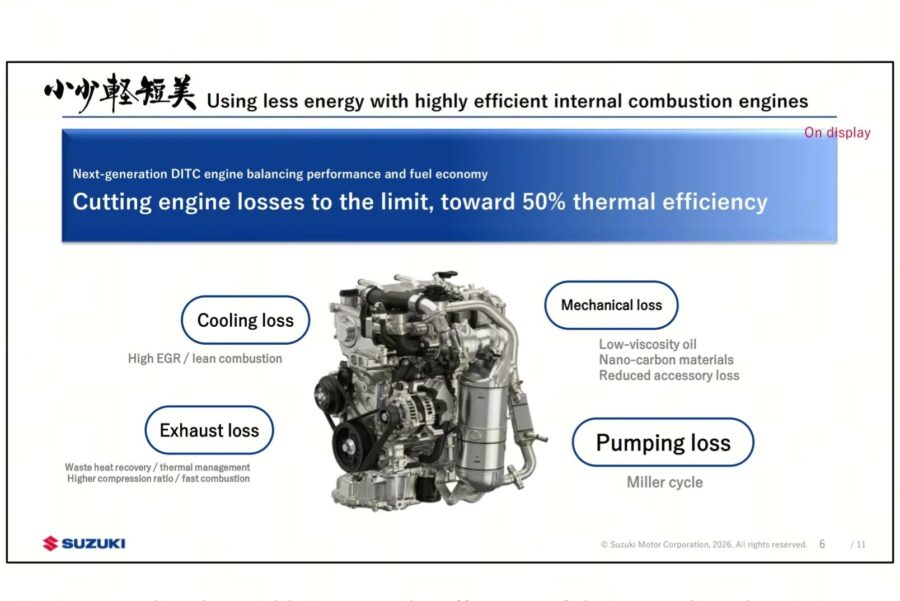
Suzuki refers to the new unit as DITC in its technology briefing. It is being developed to bring stronger performance without giving up fuel efficiency.
Key points:
- Direct-injection turbo-petrol technology
- India listed as one of the target growth markets
- Engine size and power output are not confirmed
- First Maruti Suzuki model using it is also unknown
The engine could give Maruti Suzuki another choice for SUVs where buyers want more power.
Suzuki Is Also Working On Hybrids
The turbo engine is only one part of Suzuki’s wider powertrain work. The company is also developing hybrid systems for smaller and compact cars.
Its planned 48V P2 hybrid system is designed for mini cars, with lower emissions, better fuel economy and improved acceleration. Suzuki’s comparison indicates about 15% lower CO2 emissions than its 2022 reference.
For compact cars, Suzuki is preparing a series-hybrid system. The petrol engine generates electricity, while an electric motor drives the wheels. Swift, Dzire and Baleno are useful examples of the type of cars that could suit such technology, although Suzuki has not confirmed applications.
The company is also planning REEV Light, which adds external charging to the series-hybrid setup. A smaller battery could provide electric driving while the petrol engine keeps longer trips practical.
Aiming For Better Engine Efficiency
Suzuki is also studying ways to push internal-combustion engine thermal efficiency from around 40% towards 50%. Research areas include:
- Lean combustion
- Waste-heat recovery
- Lower-viscosity engine oil
- Lower friction
- Reduced cooling and exhaust heat losses
- Lower pumping losses
These technologies are still part of Suzuki’s research work. The company has not confirmed that every measure will be used in the DITC engine.
What This Could Mean For India
Suzuki’s plans cover several types of buyers. Small cars could get simpler hybrid systems, compact models could use series or plug-in technology, while SUVs may get more powerful turbo-petrol engines.
The exact Maruti models, prices and launch timelines are still unknown. From a buyer’s perspective, the interesting part is that Suzuki is developing several powertrain options at the same time rather than relying on one technology. The approach also gives Maruti more room to match different cars with different powertrains, depending on size, usage, cost and driving needs of customers across new future models.