
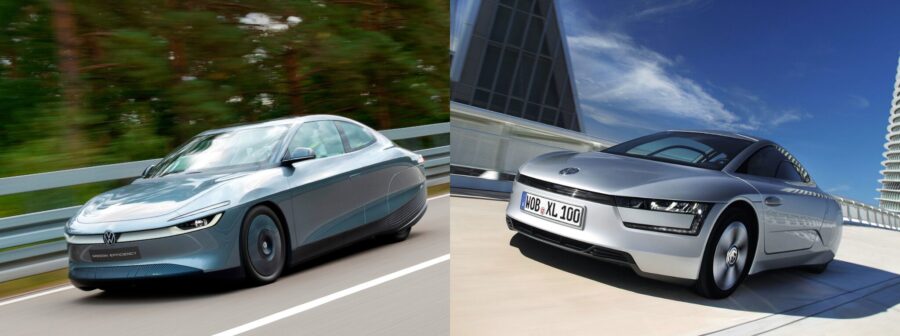
Remember the Volkswagen XL1 diesel-hybrid? Well, back in the year 2013, Volkswagen showed the world how far a car could go when efficiency was given top priority. More than a decade later, the company has brought that thinking into the electric age with the new Mission Efficiency. It is a near-production electric concept that uses familiar Volkswagen hardware but gets a very different body. as the ID. Polo and ID. Cross. However, its body is much longer, lower and more aerodynamic than a regular hatchback.
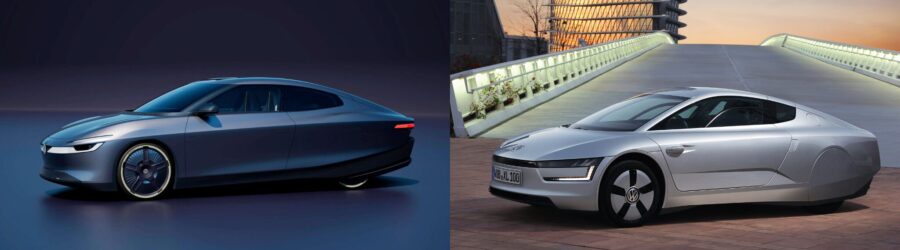
Volkswagen Mission Efficiency: Aerodynamics
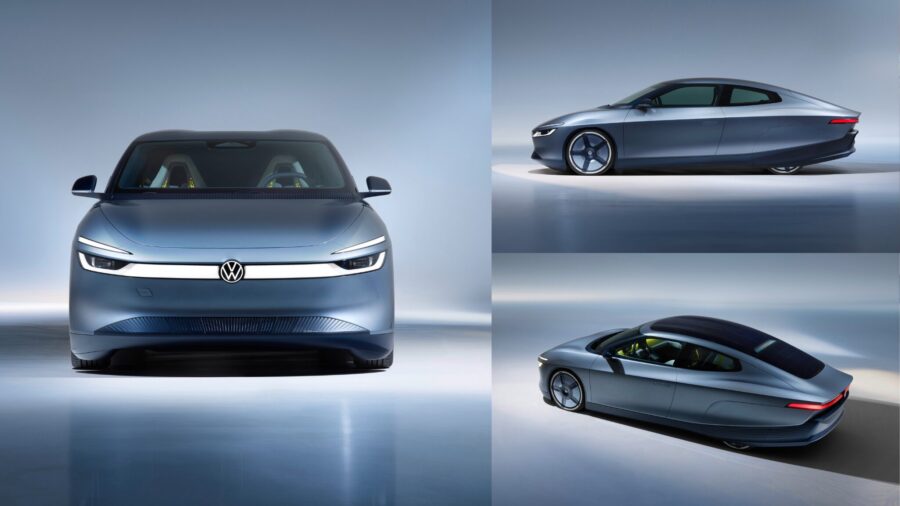
The engineering data highlights the extreme measures Volkswagen has taken with this design. The vehicle achieves a remarkably low drag coefficient of just 0.158, paired with a compact frontal area of 2.08 square metres. The body is sculpted into a classic teardrop silhouette, incorporating specialized aero-cheating elements to let air glide across the surface with minimal resistance.
- It achieves an ultra-low drag coefficient of 0.158.
- The compact frontal area measures just 2.08 square metres.
- The exterior relies on a low, highly aerodynamic 2+2 coupé silhouette.
- It utilizes covered rear wheels alongside specialized rim deflectors to clean up turbulent airflow.
- The underbody is fully sealed and covered.
- The doors feature frameless glass layouts and flush, integrated handles.
- The cooling system is managed by three active air flaps.
Volkswagen states that these aerodynamic adjustments yield massive efficiency gains at highway speeds. Above 80kmph, the Mission Efficiency consumes over 30 percent less energy compared to a standard ID. Polo. Most impressively, its energy consumption at 140kmph is claimed to be identical to a standard ID. Polo traveling at just 100kmph.
Battery, Motor And Range
The concept uses a 54.9kWh net battery paired with a 99kW electric motor. The motor produces 135PS and up to 264Nm of torque. This hardware is derived from Volkswagen’s production EV technology rather than being a completely new electric system.
Under controlled conditions, Volkswagen recorded energy consumption of 6.48kWh per 100km. Based on the same test, the theoretical range works out to around 821km. The car was also driven on a long European route from Wolfsburg to Vienna.
- Battery: 54.9kWh net
- Motor: 99kW
- Power: 135PS
- Torque: 264Nm
- Ideal test consumption: 6.48kWh/100km
- Road test consumption: 7.51kWh/100km including charging losses
- Range: Up to 821km in controlled conditions
The 1,278km journey included roads through Poland and the Czech Republic. The battery was charged only once during the trip, with 164km of estimated range left when the car reached Vienna.
Volkswagen Mission Efficiency: Interior
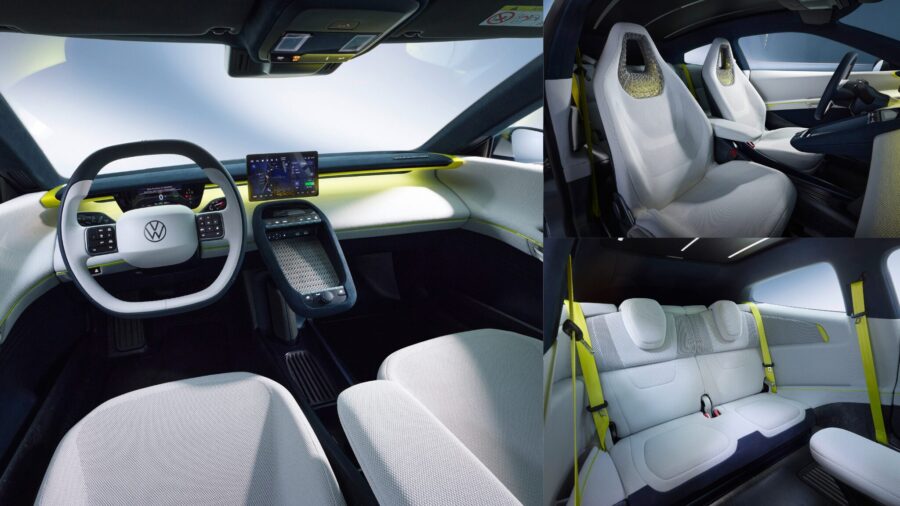
Despite its low body, Volkswagen has given the prototype four seats. The rear seats are smaller and are suitable for passengers up to around 1.60 metres tall. Boot space stands at 481 litres. Key highlights:
- 2+2 seating layout
- 481-litre luggage space
- Storage areas below the rear seats
- Storage space around the rear wheel areas
- Lightweight interior panels
- Smartphone or tablet-based display setup
- Portable Bluetooth speaker
The cabin follows the same weight-saving approach as the exterior. Volkswagen has avoided some conventional equipment and uses a bring-your-own-device approach for the infotainment display.
Solar Roof And Braking System
A 370W photovoltaic system is fitted into the glass roof and rear section. Depending on the weather, location and season, Volkswagen says it can add up to 30km of real-world range per day.
The car also gets a new electromechanical rear brake. It works with the hydraulic front braking system and can help reduce friction losses while improving energy recovery.
Production Plans
For now, Volkswagen has presented the Mission Efficiency as a near production concept and technology demonstrator. There is no confirmed production version or launch plan.
The more interesting part is that Volkswagen has achieved these figures using technology related to its regular EV range. The project shows how much range can be gained through better aerodynamics, tyres, weight and energy management.
The Mission Efficiency may not become a showroom model, but it gives a clear look at what Volkswagen can achieve when efficiency becomes the main target.
Volkswagen Mission Efficiency Specifications (Quick look)
| Specification | Details |
|---|---|
| Model | Mission Efficiency |
| Platform | MEB+ |
| Drive | Front-wheel drive |
| Motor | Electric |
| Power | 99kW / 135PS |
| Torque | 264Nm |
| Battery | 54.9kWh net |
| Claimed Range | Up to 821km |
| Drag Coefficient | 0.158 |
| Ideal Consumption | 6.48kWh/100km |
| Road Test Consumption | 7.51kWh/100km including charging losses |
| Solar System | 370W |
| Seating | 2+2 |
| Boot Space | 481 litres |