
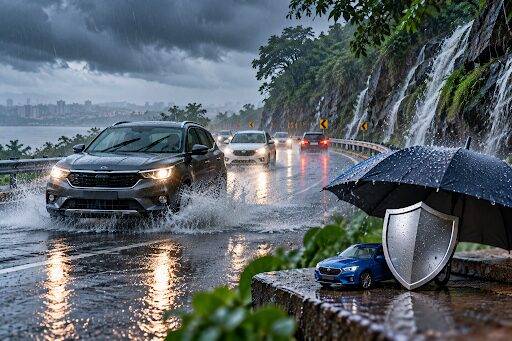
There’s something magical about driving during the monsoon in India. The ghats turn lush green, the air becomes cooler, and even your regular rides start to feel special. But the same rain can be quite tough on cars. Waterlogging, potholes, and poor visibility can cause serious wear and tear. Sometimes, these troubles lead to heavy repair costs.
That’s why it’s important to know which monsoon-related risks a standard car insurance policy covers and which ones it doesn’t. Reviewing your policy before the rainy season can save you from unexpected surprises later.
What monsoon conditions mean for your car insurance
Monsoon damage tends to fall into four broad categories, and each one is treated differently under a car insurance policy.
Water entering the engine. Driving through deep water or attempting to restart a car that has stalled in it, can draw water into the engine. This can damage internal components and lead to significant repair costs.
A parked car caught in a flood. Basement parking and low-lying streets can fill quickly during heavy rainfall and a vehicle can be damaged without being driven at all.
Skids, potholes and collisions. Wet roads reduce grip and standing water can conceal potholes deep enough to damage a wheel or the underbody. Braking distances increase and minor collisions become more common.
Getting stranded. A flat tyre on a flooded road or a battery drained after hours in traffic, can leave a vehicle immobilised when assistance is harder to reach.
What a comprehensive policy generally covers
A comprehensive policy is usually the starting point, as standard policy covers damage to the car from flood, inundation, storm, cyclone and hailstorm, along with landslide and rockslide.
This means a car damaged while parked in a flooded street is generally covered for the damage the water caused directly, subject to stated terms. A comprehensive car insurance policy from leading insurers like Zurich Kotak General Insurance can cover the cost of moving a damaged car to the nearest repairer and returning it to you afterwards, up to ₹1,500 for any one accident.
The engine damage a standard policy excludes
A standard policy pays for damage caused directly by an insured event, such as a flood. Damage that follows on from that event, as a knock-on effect, is usually left out.
Engine damage caused by water is the common example. Water usually enters the engine when a car is driven through or started in standing water, and the failure that follows falls outside the standard cover.
An engine protection add-on is written for this situation. It covers repair or replacement of engine, gearbox and differential parts damaged by water getting in, or by oil leaking out. It applies alongside an admissible own damage claim, so the flood damage to the car and the engine damage are handled together. Claims reported more than 30 days after the event may not be accepted, although insurers may consider a late claim where there is a valid reason.
What roadside assistance covers during the rain
Roadside assistance is there to help when your car can’t go further. Depending on your policy, it could include:
– Towing to the nearest garage (up to 50 km).
– A battery jump start.
– Help with a flat tyre.
– A technician for small repairs that don’t need spare parts.
Some plans also help with travel arrangements if your car breaks down more than 50 km away from your registered address.
Keep in mind:
– Most policies set a limit on the number of requests, usually up to four in a year.
– Some policies may not cover service during extreme weather conditions or if your car can still be driven safely.
Depreciation cover and consumables cover
Monsoon damage often involves bumpers, lights and underbody panels made of plastic and rubber. Under a standard policy, depreciation is deducted on such parts, which can be as high as 50%.
Depreciation cover removes that deduction on covered claims, for the number of claims set out in the policy schedule. A consumables cover pays for items such as engine oil, oil filter, brake oil, nuts and bolts, which a flood-related repair can use up.
Which cover responds to which monsoon risk
| Monsoon risk | Cover that responds |
|---|---|
| Vehicle damaged by flood or storm | Comprehensive policy |
| Engine damaged by water ingress | Engine protection add-on |
| Immobilised by a flat tyre or dead battery | Roadside assistance add-on |
| Depreciation deducted on plastic parts | Depreciation cover |
| Oil and fluids replaced after a flood | Consumables cover |
What to keep in mind if a vehicle is caught in water
If a vehicle stalls in standing water, avoid attempting to restart it until the vehicle has been assessed. Starting the engine after water has entered the vehicle can result in further engine damage, which may have different coverage implications.
Policyholders should intimate the insurer and follow the applicable claims process before repairs begin. Photographs of the vehicle and surrounding conditions can also provide useful information for the claim assessment.
The renewal date is also relevant before the rains. A policy that has expired does not provide cover for losses occurring after the expiry of the policy period.
Conclusion
Monsoons can be tough on your vehicle, but a comprehensive policy can help cover most of the damage caused during this season. However, a few things may not be covered, like:
– Engine damage due to water entering the engine
– Roadside assistance
– Depreciation on plastic parts
But don’t worry, you can get add-ons for these. Think about where you drive and park your car. This will help you decide which covers make sense for you. Many insurers in India provide useful add-ons like roadside assistance and engine protection along with a comprehensive policy.
Before the rain starts, check your car insurance. Look at the covers you have, the renewal date, and the terms of your policy. This way, you’ll know how protected your car is during the monsoon.