
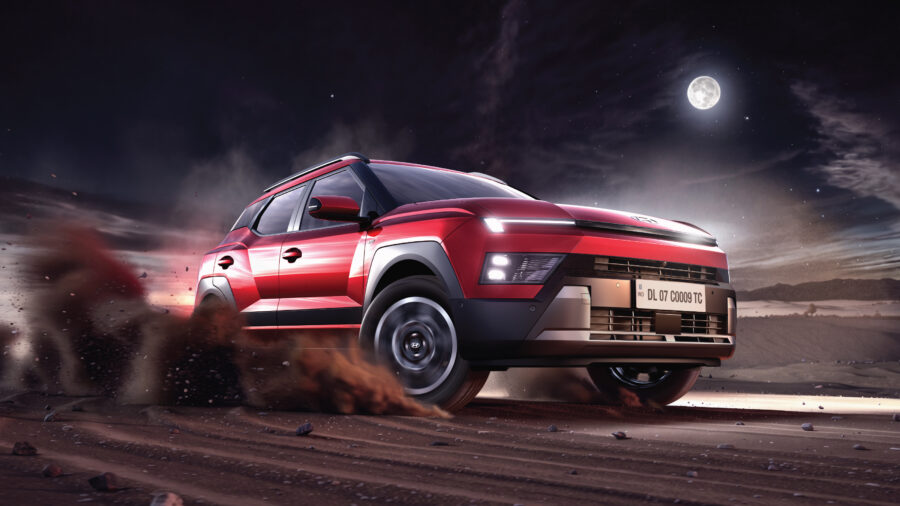
Finally!!! Hyundai’s much-awaited Bayon SUV has been launched in India at an introductory price of Rs 9.99 lakh (ex-showroom). The new model brings a different design, a feature-loaded cabin and a familiar 1.5-litre petrol engine. It will be positioned below the Creta and will also be manufactured in India for export markets.
The Bayon will be available in seven variants, with manual and automatic gearbox options. Hyundai has also confirmed a factory-fitted CNG version, which is scheduled to arrive in January 2027.
Hyundai Bayon Price And Variants
The new SUV is available in seven trims, starting with the HX2 and going up to the HX10. While the entry-level version gets a manual gearbox, automatic options are available from the HX5 variant onwards.
| Variant | Transmission |
|---|---|
| HX2 | Manual |
| HX3 | Manual |
| HX3+ | Manual |
| HX5 | Manual / CVT |
| HX6 | Manual / CVT |
| HX8 | Manual / CVT |
| HX10 | Manual / CVT |
The starting price is Rs 9.99 lakh, ex-showroom. Prices for the remaining variants have not been announced in the available launch details. Bookings are open through Hyundai dealerships and the company’s official website, with an initial booking amount of Rs 11,000.
Exterior Design And Dimensions
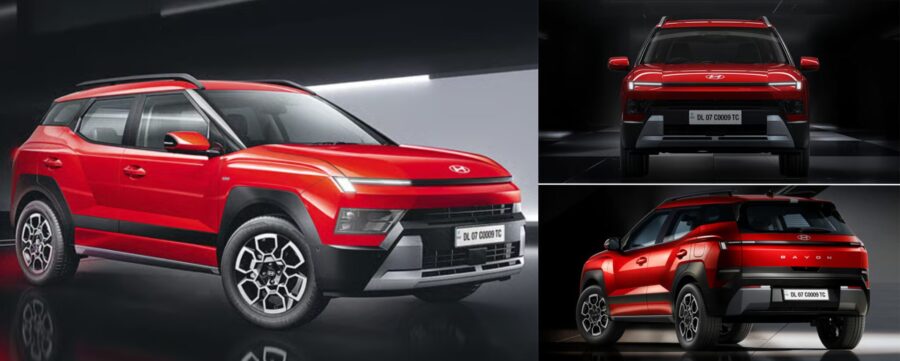
The Bayon introduces Hyundai’s Art of Steel design language in India. Its body features sharp lines, sculpted panels, flared wheel arches and thick black cladding. The front gets LED projector headlamps and inverted L-shaped LED daytime running lights, which also function as turn indicators.
Unlike several recent Hyundai models, the Bayon does not use a full-width light bar at either end. The rear features slim LED tail-lamps housed around a black strip, BAYON lettering on the tailgate and a roof spoiler with an integrated high-mounted stop lamp. The bumpers receive a dual-tone black-and-silver finish.
Other exterior features include:
- 17-inch alloy wheels with 215-section tyres
- Dual-tone outside rear-view mirrors
- Roof rails
- LED reversing lights
- Six front and six rear parking sensors
- 360-degree camera
- All-four-wheel disc brakes
- Tyre pressure monitoring system (TPMS)
Hyundai Bayon Dimensions
| Specification | Details |
|---|---|
| Length | 4,245 mm |
| Width | 1,810 mm |
| Height | 1,605 mm |
| Wheelbase | 2,600 mm |
| Ground clearance | 205 mm |
| Boot space | 505 litres |
| Fuel tank capacity | 43 litres |
The SUV measures slightly less than 4.3 metres in length. Its 2,600 mm wheelbase and 505-litre boot capacity are among the key figures for buyers considering the vehicle for everyday use and longer journeys.
Colour Options
Hyundai is offering the Bayon in several exterior shades, including matte finishes and dual-tone combinations.
The available colours are:
- Fiery Red
- Classy Blue
- Classy Blue Matte
- Atlas White
- Titanium Black
- Titanium Matte Black
- Golden Bronze
- Ecotronic Grey
Fiery Red and Atlas White can be ordered with a contrasting black roof. This gives buyers additional scope to personalise the SUV’s appearance.
Cabin, Screens And Comfort Features
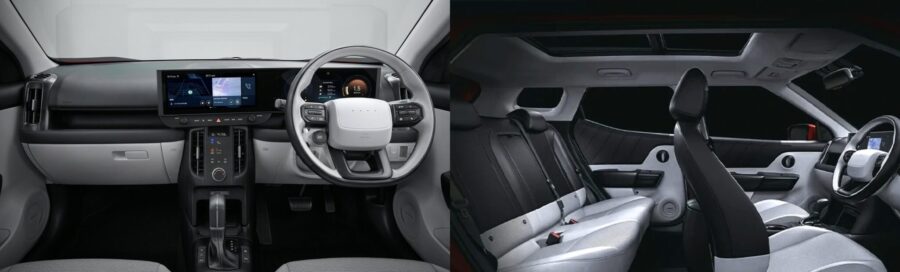
The dashboard layout takes inspiration from the Brazil-spec i20, with two large displays positioned next to each other. Depending on the variant, the cabin will be offered in an all-black or black-and-white theme, with leatherette upholstery and soft-touch elements.
The digital driver’s display and touchscreen measure 12.3 inches each. Hyundai has also retained physical buttons and shortcut controls, making important functions easier to access while driving.
The main interior features include:
- Dual 12.3-inch displays
- Wireless Android Auto and Apple CarPlay
- Ventilated front seats
- Electrically adjustable driver’s seat
- Panoramic sunroof
- Automatic climate control
- Rear AC vents and a rear centre armrest
- Two-step reclining rear seats
- Wireless phone charging and Type-C USB ports
- Ambient lighting
- Eight-speaker Bose sound system with a subwoofer
- Single-channel dashcam
- Sunglass holder and LED reading lights
- Manually dimming inside rear-view mirror
- Electronic parking brake with auto hold
The steering wheel houses the drive mode selector, while paddle shifters are available with the CVT-equipped versions. Three driving modes, Eco, Normal and Sport, are offered.
Hyundai has also equipped the Bayon with Bluelink connected-car technology, over-the-air updates and a voice assistant powered by generative AI. The system supports more than 500 voice commands, while the connected-car package offers over 70 functions. OTA updates can be delivered to 19 controllers, supporting the SUV’s software-defined vehicle functions.
Engine, Gearbox And Mileage
The Bayon uses a 1.5-litre, four-cylinder, naturally aspirated petrol engine. This is the same basic engine configuration found in the Creta, and it is offered with two transmission choices.
| Specification | Details |
|---|---|
| Engine | 1.5-litre naturally aspirated petrol |
| Cylinders | 4 |
| Maximum power | 115 PS |
| Peak torque | 144 Nm |
| Gearbox | 6-speed manual / CVT |
| Drivetrain | Front-wheel drive |
| Claimed mileage | 18.6 km/l (CVT) |
Hyundai has also included a Dash Boost function, which is claimed to provide an immediate power boost during overtaking. The SUV does not currently get a turbo-petrol or diesel engine option.
A factory-fitted CNG version is confirmed for January 2027. It will use the 1.5-litre petrol engine, although detailed CNG specifications and prices have not yet been announced.
Safety Features And Crash Testing
Safety equipment includes six airbags, Level 2 ADAS, electronic stability control, hill-start assist, a tyre pressure monitoring system and a 360-degree camera. The SUV also gets front, side and rear parking assistance, along with disc brakes on all four wheels.
Hyundai says the Bayon has been engineered to meet five-star Indian crash safety standards. The vehicle uses the Global K enhanced platform and reportedly incorporates 69 per cent high-strength steel. Its Bharat NCAP crash-test results are expected by the end of 2026.
The company lists 35 standard safety features, with the total increasing to as many as 85 features on higher variants. The exact equipment available will depend on the trim level.
Hyundai Bayon Rivals
The Bayon will compete with several petrol-powered SUVs in India, including the Kia Seltos, Honda Elevate, Skoda Kushaq, Volkswagen Taigun and MG Astor. Other models buyers may consider include the Tata Sierra, Tata Curvv and Maruti Suzuki Victoris.
The Hyundai Creta will also be an important point of comparison, particularly for customers deciding between the two models. With the Bayon, Hyundai is introducing a smaller SUV with distinctive styling, a long equipment list and a naturally aspirated petrol engine.