
Last updated: June 2026
IDV (the most your insurer pays if the car is stolen or written off) is roughly your car’s market value today, and add-ons are extra covers that fill gaps the basic policy leaves out. Set the IDV near the car’s value and pick only the add-ons it needs, and your car insurance premium stays fair while the claim holds up.
What Should Every Car Owner Know About IDV?
Every car owner should know that IDV is the fixed amount the insurer pays if the car is stolen or damaged beyond repair. It is roughly the car’s market value today, calculated as the showroom price minus the depreciation for the car’s age. So the IDV falls slightly each year as the car gets older.
The IDV applies only to your own car cover. It does not apply to the third-party part of the policy, which only pays for harm you cause to others.
How Does IDV Affect an Owner’s Premium?
A car owner’s premium rises with a higher IDV, and a higher IDV also means a bigger payout. A lower IDV cuts the premium but leaves you with a smaller payout. The sensible choice is to keep the IDV close to the car’s real market value, so you neither pay too much nor end up short.
Say the car is worth about ₹6 lakh today. An IDV near ₹6 lakh keeps the payout fair without pushing up the premium. Setting it far lower to save a little premium can cost you a lot if the car is stolen.
IDV only pays out when the car is a total loss or stolen. For an ordinary repair after an accident, IDV does not come in; the add-on that protects your repair bill is zero depreciation.
Which Add-Ons Should a Car Owner Consider?
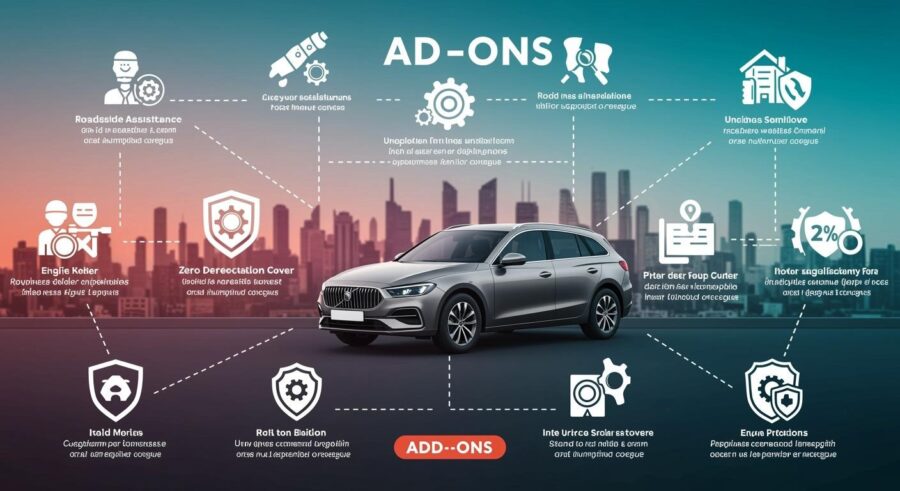
A car owner should consider add-ons as extra covers bought on top of the basic policy. You pay a little more premium for each. The common ones are:
- Zero depreciation: the insurer does not cut for wear on replaced parts, so your repair claim pays more.
- Return to invoice: pays the original invoice value, not the lower IDV, if the car is stolen or written off.
- Engine protection: covers engine damage from water or oil leakage, which the basic policy leaves out.
- Roadside assistance: towing and on-spot help if the car breaks down.
- NCB (no-claim bonus, a discount for not claiming) protect: keeps your discount even after you make a claim.
How Can a Car Owner Choose the Right Add-Ons?
A car owner can choose the right add-ons by matching them to the car’s age and driving habits. Buying the whole list wastes money. A newer car suits zero depreciation and return-to-invoice because the parts prices and invoice value are still high. A car parked in a flood-prone area is better protected from engine damage.
An insurer with a fully online journey, such as ACKO, lets you set the IDV and turn each add-on on or off while the price updates. Look at the claim record too, not only the price. Across the wider market, the non-life insurance industry’s incurred claims ratio was 82.52% in FY24.
Frequently Asked Questions
Is a higher IDV always better?
No, a higher IDV is not always better. It raises your premium, and a value set above your car’s market price will not pay out more on a claim. Keep it close to what the car is worth today.
Can you increase or change your IDV?
Yes, you can usually adjust the IDV within a set band when you renew, often around 15% either way. Ask your insurer for the range, since a value far from the market price can be questioned at claim time.
Is zero depreciation worth the extra premium?
For a car under five years old, zero depreciation is often worth it because part prices are high and the wear cut on a repair claim can be large. For an older car the savings are smaller.
What is the difference between return to invoice and zero depreciation?
Return to invoice pays your original invoice value on theft or total loss. Zero depreciation pays the full part cost on a repair, with no wear deduction. One covers total loss, the other covers repairs.
Are car insurance add-ons worth it?
It depends on your car and how you drive. Buying every add-on wastes money, but skipping the ones that match your risk, such as engine protection in a flood-prone area, can leave a costly gap.
Key Takeaways
- IDV is the most you get if the car is stolen or written off, so set it near the car’s real market value.
- A higher IDV raises your premium and a low IDV cuts your payout, so match it to the market value, not the lowest price.
- Add-ons fill the gaps a basic policy leaves, and zero depreciation and return to invoice are the common ones.
- Pick add-ons by your car’s age, use, and location, not by buying the full list.