
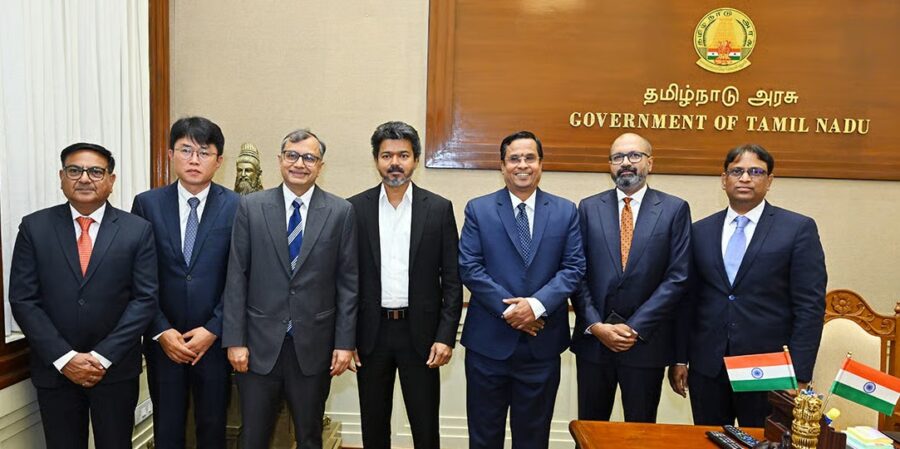
Recently, Hyundai Motor India announced a major expansion plan for Tamil Nadu. The company has confirmed that the state will play a very crucial role in its future electric vehicle strategy, manufacturing operations, supplier network and workforce development programs.
The announcement comes at a time when Hyundai is preparing to introduce new products for the Indian market, including its first dedicated mass-market electric vehicle.
New Hyundai Electric SUV Arriving Soon
One of the biggest developments is the arrival of Hyundai’s new electric SUV. The company has confirmed that two new models will roll out from its Chennai plant this year, and one of them will be a dedicated EV developed for the mass market.
The upcoming model is expected to enter the compact SUV segment.
Expected details include:
| Particulars | Details |
|---|---|
| Segment | Sub 4 metre electric SUV |
| Internal Code | HE1i |
| Expected Rivals | Tata Nexon EV, Mahindra XUV 3XO EV |
| Platform | Hyundai-Kia E-GMP (K) |
| Battery Options | Standard and Long Range |
| Expected Range | More than 300 km |
| Production Location | Chennai, Tamil Nadu |
Reports suggest battery pack options could be similar to the international Hyundai Inster EV, which uses 42 kWh and 49 kWh battery packs.
Tamil Nadu To Play A Bigger Role
Hyundai has already taken several steps to strengthen its EV operations in the state.
Some key developments include:
- Tamil Nadu’s first EV battery sub-assembly plant established by Hyundai
- Local production of power electronics and key EV components
- Manufacturing support for domestic and export markets
- Expansion of EV-related supply chains
The company also plans to use India as an export base for future electric vehicles.
So far, more than 3.9 million Hyundai vehicles produced in Tamil Nadu have been exported to over 150 countries.
Localisation To Increase Further
Hyundai has outlined plans to increase localisation across both petrol and electric vehicles.
Current and future targets include:
- Current localisation level: 82%
- Planned localisation level: 90%
- Timeline: Next 5 to 6 years
The company will also increase sourcing from suppliers based in Tamil Nadu.
| Plan | Target |
| Additional supplier sourcing | Rs 4,000 crore |
| Expected new jobs | Around 2,000 |
| Timeline | 5 to 6 years |
This move is expected to strengthen local manufacturing while reducing dependence on imported components.
Charging Network Expansion
Hyundai is also working on charging infrastructure across the state.
Current network includes:
- 39 DC fast charging stations
- 78 charging points
The company plans to expand this network further over the next few years as more electric vehicles join its portfolio.
Skill Development Program Announced
Apart from vehicle manufacturing, Hyundai has also partnered with the Tamil Nadu government for a large skill development initiative. The program is scheduled to begin operations in December 2027. Training areas will include:
- Electric vehicle technology
- Hydrogen mobility
- Robotics
- Automation
- AI-enabled manufacturing
- Smart factory systems
- Workplace communication skills
- Language training
The state government will work closely with ITIs, engineering colleges, polytechnics and skill development institutions to support the initiative.
Rs 26,000 Crore Investment Commitment
Hyundai has reaffirmed its plan to invest more than Rs 26,000 crore in Tamil Nadu between 2023 and 2032. This investment forms part of the company’s broader Rs 45,000 crore commitment announced earlier.
The funds will support:
- Manufacturing expansion
- EV development
- Localisation projects
- Innovation programs
- Sustainability initiatives
- Employment generation
With a new electric SUV on the way, higher localisation targets, supplier expansion and large-scale investment plans, Hyundai is preparing for its next phase of growth in India. Tamil Nadu will continue to remain one of the company’s most important manufacturing and export bases while also supporting its future electric mobility ambitions.