
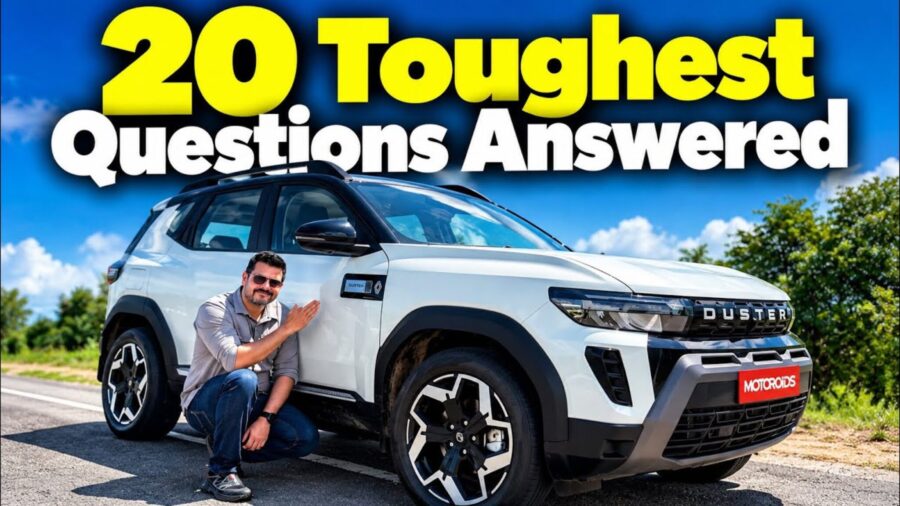
So, our most comprehensive review of the newly launched Duster Hybrid is finally here. Renault has gone out of the box with this SUV and brought some genuinely advanced hybrid technology to the segment. The Duster gets a 1.8-litre petrol engine, a large hybrid battery, two electric motors and a rather unusual transmission.
But numbers alone do not tell the full story.
Does it actually give good mileage in daily driving? Is the hybrid system smooth? How does it compare with the Toyota Urban Cruiser Hyryder and Maruti Suzuki Grand Vitara? What happens to performance, boot space and equipment compared with the 1.3 Turbo DCT?
For easy understanding, we have divided this review into 20 questions. These should clear most of the doubts a buyer may have about the new Duster Hybrid.
1. What does the hybrid get over the 1.3 Turbo DCT?
The hybrid gets a much more advanced powertrain and a different suspension setup.
Key additions include:
- 1.8-litre Atkinson-cycle petrol engine
- 1.4kWh battery
- Two electric motors
- 160PS combined power
- Four-speed dog-clutch transmission
- Frequency Selective Damping (FDD)
- Hybrid-specific displays and controls
- B mode for stronger energy recovery
- E-Save function
The illuminated grille and E-Tech badges also help identify the hybrid version.
2. What features are missing?
The hybrid is not simply a more expensive version with extra technology. Some equipment has been left out.
It misses:
- 360-degree camera
- ADAS
- Automatic headlights
- High-beam assist
- Auto-dimming inside mirror
- Lumbar support
- Paddle shifters
- Manual gear selection
- Steering weight adjustment
Boot space is also lower because of the battery packaging.
3. Is the cabin spacious?
Yes, there is good room inside.
The rear seat has enough space for average-sized adults, and the redesigned rear headrests improve the view for passengers.
The cabin also gets useful features such as ventilated seats, a panoramic sunroof, wireless charging and a large centre storage area with an armrest.
4. What exactly is the hybrid system?
The Duster uses a 1.8-litre Atkinson-cycle petrol engine with a 1.4kWh battery and two motors.
One motor drives the wheels. The second motor works as a starter-generator and also helps with engine operation, gear changes and battery charging.
The combined system produces 160PS.
The petrol engine itself makes 109PS and 172Nm. The starter-generator produces around 20PS, while the traction motor produces 50PS and 205Nm.
5. Why does it use a 1.8-litre engine?
A bigger engine may sound strange in a hybrid designed for mileage.
Here, the engine is designed to work with the electric system. Its Atkinson-cycle setup helps it operate efficiently, while the electric motor provides extra torque when required.
This also means the petrol engine does not have to do all the work on its own.
6. How does the unusual transmission work?
This is one of the most interesting parts of the Duster.
The transmission has four mechanical ratios for the engine and two speeds for the traction motor. It uses a dog-clutch arrangement rather than a normal torque converter or CVT.
During a gear change, the electric motors help manage the torque while the engine speed is matched. This allows the gears to engage without the driver feeling a large interruption.
There are no paddle shifters or manual gear selection.
7. Is it quicker than other strong hybrids?
The Duster feels quite quick because the electric motor delivers torque immediately.
Renault claims a 0-100km/h time of 9.6 seconds. In the test, with two people and luggage, it managed the run in just over 10 seconds.
That is quick enough for everyday driving and highway overtakes.
8. How does it compare with Hyryder and Grand Vitara?
The Duster takes a different approach.
Compared with the Toyota Urban Cruiser Hyryder and Maruti Suzuki Grand Vitara hybrids, it has:
- A larger 1.4kWh battery
- More powerful electric motor
- More powerful overall system
- Larger and heavier SUV platform
- Higher ground clearance
- More substantial road manners
- A different multi-mode transmission
The Duster also offers strong hybrid efficiency despite its larger size.
9. What mileage can you expect in the city?
This is where the Duster Hybrid makes a strong case.
During the test, around 30km of city driving in traffic returned close to 26-27km/l.
The claimed figure is 29km/l, so getting into the mid-20s in real traffic is a strong result.
Driving style matters a lot. Smooth acceleration and early lifting of the throttle help the hybrid use its battery more often.
10. What happens on the highway?
Highway mileage is lower than city mileage, especially when the road is open and the car is travelling at a steady speed.
At 90-100km/h, the test returned around 14.5km/l over roughly 30km.
With more traffic and regular deceleration, the number can rise to around 18-19km/l. A mixed city and highway run can get close to 20km/l.
Under hard driving, the lowest tested figure was around 8.5km/l.
11. Can it really drive mostly on electric power?
The answer is quite close to Renault’s claim.
Renault says the Duster can run in EV mode for nearly 80% of city driving. A test covering around 20km recorded about 75% EV running.
The exact number will depend on traffic, throttle use, road conditions and battery charge.
Still, 75% is a very high share for real-world city driving.
12. How should you drive it for better mileage?
The Duster rewards smooth driving.
A few useful habits are:
- Use gentle throttle inputs.
- Look ahead and lift off early.
- Avoid unnecessary hard acceleration.
- Use B mode when stronger energy recovery is useful.
- Let the hybrid system manage the engine and battery.
- Use Eco mode when mileage is the priority.
The less you disturb the system with sudden inputs, the easier it is for the car to make use of electric power.
13. Is the transmission smooth?
Yes, and this is one of the strongest parts of the car.
Gear changes are not as sharp as a DCT, but they are generally difficult to notice during normal driving. The electric motor helps cover the torque gap during shifts.
There is some engine sound when the throttle is pushed hard, but normal driving is quiet.
The response to the accelerator is also quick, without the rubber-band feeling associated with some CVT-style hybrids.
14. How does it handle?
The hybrid is more comfort-oriented than the 1.3 Turbo DCT.
The steering feels lighter around the centre, while the suspension is softer. This makes the car comfortable over broken roads but takes away some of the sharper feel of the petrol Duster.
For a driver who wants comfort, this setup works well.
For someone who enjoys attacking corners, the 1.3 Turbo DCT remains the more interesting choice.
15. How good is the ride?
Very good!
The FDD suspension helps the Duster deal with poor surfaces and sharp bumps. The hybrid is also around 80kg heavier than the petrol version, so its suspension has been retuned.
There can still be some movement over large undulations at higher speeds, but the ride is one of the stronger parts of this SUV.
16. Is it a driver’s car?
Not exactly.
The Duster Hybrid is brisk and can be enjoyable, but it does not give the driver the same level of control as a turbo-petrol DCT SUV.
There are no paddles and no manual gear selection. The softer suspension also limits its cornering appeal.
So, it is fun enough, but enthusiasts looking for sharp responses may prefer the 1.3 Turbo DCT.
17. How quiet is the cabin?
Cabin insulation is one of the good points here.
Tyre and outside noise are well controlled. The car can feel almost silent when it is running on electric power.
The petrol engine becomes more noticeable when pushed hard, but it is not excessive during normal driving.
18. Is the hybrid system reliable?
The latest E-Tech system is still relatively new, so a very long-term verdict is not possible yet.
Earlier versions of Renault’s E-Tech technology had some reported problems and recalls. The newer system has had a much better record so far.
Renault also provides substantial warranty cover:
- 7-year warranty for the hybrid powertrain system
- 8-year warranty for the battery
This should give buyers some additional confidence.
19. What drive modes are available?
There are no conventional Sport, Normal and Eco modes.
Instead, the Duster gives you a few different functions.
Eco: Helps prioritise fuel efficiency.
B mode: Increases energy recuperation when lifting off the accelerator.
E-Save: Gives more importance to charging and maintaining battery energy rather than chasing the lowest possible fuel consumption.
These controls are useful when you want to manage how the hybrid behaves.
20. Is the Duster Hybrid worth buying?
The Duster Hybrid has a clear strength: it combines strong hybrid technology with a larger SUV package.
It offers good city mileage, quick acceleration, a comfortable ride and a well-insulated cabin. The 1.4kWh battery and multi-mode transmission also make it technically different from the usual strong hybrids.
There are compromises too. The boot is smaller, there is no ADAS or 360-degree camera, and enthusiasts may miss the sharper responses of the 1.3 Turbo DCT.
Final verdict
The Duster Hybrid is not perfect, but it gets the important things right. It is comfortable, efficient, quick enough and packed with interesting engineering.
For buyers who spend a lot of time in the city and want strong mileage without moving to a smaller SUV, it makes a lot of sense. Those looking for a more engaging driving experience should still look at the 1.3 Turbo DCT.
A test drive is the best way to decide. The hybrid system is quite different from what most buyers are used to, and that is also what makes this Duster interesting.