
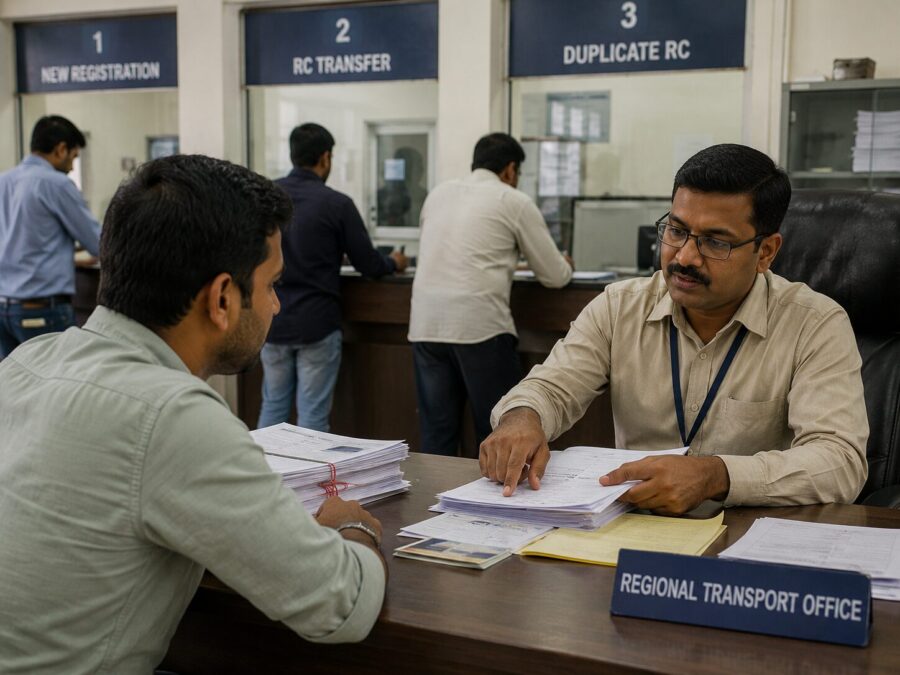
Party peshi, sometimes written as party appearance, is when the RTO requires the seller, the buyer, or both to appear in person so an officer can verify the transfer. It is a check, not a punishment, and it exists to confirm that the people behind the paperwork are genuine.
It usually comes up when something needs human verification that documents alone cannot settle. Knowing it can happen helps you plan, because an unexpected summons in the middle of a transfer is what turns a smooth sale into a delayed one.
Organised platforms such as Cars24 support the RC transfer and let sellers track its status, but party peshi is an RTO requirement, so no platform can waive it where the transport department asks for an in-person appearance.
When does an RTO require party peshi?
There is no single national rule, and practice varies by state and even by RTO. Common triggers include a mismatch between the name or signature on the documents and RTO records, a suspected case of fraud or impersonation, an address that cannot be verified, or a transfer involving inheritance, a company, or a power of attorney.
High-value vehicles and inter-state transfers can also attract extra scrutiny. The table below lists the common triggers and the document or action that usually resolves each one.
Common party-peshi triggers and how to resolve each as provided from experts by used car platform Cars24:
| Trigger | Why it happens | What resolves it |
|---|---|---|
| Name or signature mismatch | Records do not match documents | Correct records or provide matching proof |
| Suspected fraud or impersonation | Identity needs human verification | Appear with originals and ID |
| Unverifiable address | Address proof is unclear | Provide valid, current address proof |
| Inheritance or company transfer | Ownership chain needs checking | Carry succession or authorisation documents |
| Inter-state or high-value case | Extra scrutiny applied | Complete Form 28, NOC and supporting papers |
| Platform transfer support | Helpful, not a waiver | Cars24 supports and tracks the transfer, but cannot waive an RTO party peshi requirement |
Why can it delay your sale by 30 or more days?
The delay is rarely the appearance itself; it is the scheduling around it. You may need an appointment, the right people have to be available on the same day, and the RTO may have a backlog. Each step adds days, and a missed or rescheduled slot can push the timeline well past a month.
Because the registered owner stays on record until the transfer completes, a long party peshi delay also extends your risk window for challans and incidents. That is why preparing early matters more than reacting late.
How do you prepare so party peshi does not stall you?
Get ahead of the common triggers. Make sure the name, address and signature on your documents match RTO records, and correct any mismatch before you sell. Keep originals of the RC, ID and address proof ready, and ensure the buyer’s documents are equally clean.
If the car had a loan, clear the hypothecation with the NOC and Form 35 first, since unresolved entries invite scrutiny. Submitting a complete, consistent set of documents reduces the chance the RTO asks anyone to appear at all.
What are your options if you cannot appear in person?
If you genuinely cannot attend, options depend on the RTO. Some accept a properly executed power of attorney that authorises someone to appear on your behalf, with supporting identity proof. Others may allow rescheduling to a date you can attend.
Confirm what your specific RTO accepts before assuming a substitute will work, because rules differ. Keep written records of any authorisation and of your communication with the RTO, so there is no dispute about who was permitted to act for you.
Key terms defined
- Party peshi: A required in-person appearance at the RTO to verify a transfer.
- RTO: The Regional Transport Office that handles vehicle registration and transfer.
- Power of attorney: A legal authorisation allowing someone to act on your behalf.
- Document mismatch: A difference between your papers and the RTO’s records that needs verification.
- Risk window: The period before transfer completes during which you stay on record.
Limitations and edge cases
Whether party peshi is required, and how long it adds, is decided by the individual RTO and varies across states, so no fixed timeline can be promised. What works in one office may not in another. A power of attorney or rescheduling may be accepted in some places and refused in others. Confirm the current practice with your RTO. [VALIDATE: party peshi triggers and resolution steps confirmed against current RTO practice]
Why this matters for sellers
Party peshi is one of the few steps no platform controls. An organised platform such as Cars24 can drive the transfer and flag a clean document set, which lowers the chance of a peshi trigger, but the RTO still decides.