
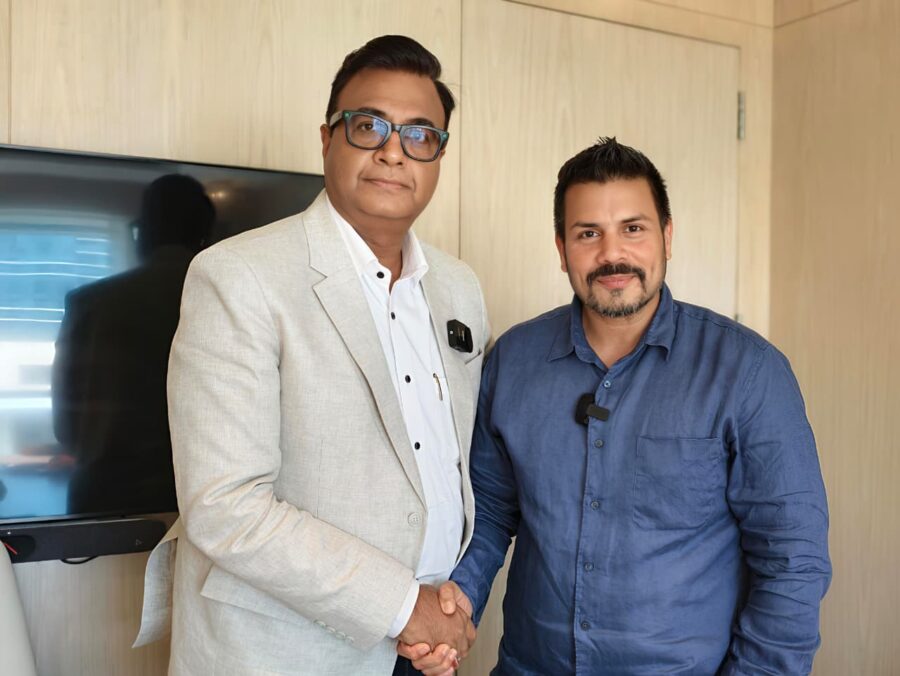
Partho Banerjee, Senior Executive Officer, Sales and Marketing, Maruti Suzuki India, speaks to Amit Chhangani about CNG’s changing image, the Brezza Turbo’s transmission choice, evolving customer mindsets, the new Kharkhoda plant, safety, ethanol and flex fuel, premiumization, industry growth, and the e-Vitara. At the heart of the conversation is how Maruti Suzuki is gearing up for a new-age customer, one defined more by mindset than age. Here’s the interview.
Q: Underbody CNG on products like the Vitara Brezza seems to have changed how buyers see CNG. What’s driving that?
Earlier, CNG meant one thing to a customer: value for money, lower running cost, nothing more. That’s genuinely changing now. With underbody CNG, we’re seeing customers, including a good number switching out of diesel, come to CNG not just for the total cost of ownership, but for the product itself and for the boot space it doesn’t eat into. There’s a feeling of “no compromise” now, even among customers who, if you’re honest about it, don’t really need that boot space in their day to day use. It’s become as much a product decision as an economic one.
The numbers back this up. CNG today is 22% of industry volumes. Diesel sits at 18%. That gap between the two is only going to get wider from here.
Q: The 1.0-litre Turbo engine in the Brezza doesn’t come with an automatic option, even with automatic demand on the rise. Why?
I want to be clear this was a considered call, not something we missed. The 1.0-litre Turbo is calibrated differently in the Fronx versus the Brezza, and the customer we’re building the Brezza Turbo for is chasing “fun,” a peppy feeling, more zip. Putting an automatic on that engine would have meant giving up the power and torque delivery that was the entire design goal of the Turbo variant. It also would have pushed the price band to a different level altogether, which isn’t where we want that product to sit.
If a customer wants an automatic, it’s available on the 1.5-litre variant. On the engineering side, the brief for the 1.0-litre was specifically to make it better than the 1.2-litre, particularly in city driving conditions, by getting peak torque at low RPM. That’s a very deliberate, city-first tune, not an oversight.
Q: How is Maruti Suzuki thinking about customer segmentation, especially with the updated Brezza?
India’s demographics are getting younger, no question. But we’re increasingly looking at psychographics over demographics, mindset matters more to us than age as a number. Someone who isn’t technically Gen Z can still have the mindset of wanting the thrill of driving, and we don’t want to write that customer off just because of their birth year.
Broadly, we see three mindsets playing out in the market right now. The first is the city driving thrill seeker, who wants fun and excitement in everyday city driving, and for them the Turbo engine delivers the zip they’re after. The second is the weekend long-drive customer, who enjoys long drives and wants higher speed and refinement, and for them the 1.5-litre engine with six gears is the fit. The third is the customer looking for a combination of mileage and features, someone who wants city drivability along with good mileage and features, and for them underbody CNG, calibrated for city driving, is the answer.
Maruti basically stands for mileage, reliability and a very good service network. What we are saying now is that the products we offer to young India are going to be lifestyle products. We are not taking away any of that strength, be it the mileage, our assured service network, or the quality. On top of it, we are adding the aspiration part, how we can be more and more appealing to the young Indian customer. And when I say young India, I don’t mean only the age part of it. There are people who are young by heart and by mindset too, and we are trying to appeal to them as well. That’s how we have created three products within the Brezza itself, to cater to these different mindsets of customers and cover the entire spectrum.
Q: What are some of the changes you’re observing in the market? Is this a small shift in customer preference, or something more tectonic, something the industry hasn’t seen before?
If I talk about today’s young India, one thing is clearly coming out. They live their life to the fullest. They want to enjoy the moment. It’s the experience that matters more to them now. That doesn’t mean they’ve stopped looking for value, nobody should think mileage and those other things don’t matter anymore. But yes, the primary reason for buying a car today is no longer mileage. It’s still there, but it’s not at the top of the list anymore. That’s the difference I’m seeing in young India, and a lot of it comes down to India growing at a phenomenal rate, GDP growth of 6.3 to 6.5%, which makes a real difference. People have got good wallet power now, and that’s clearly coming through. They’re comfortable trading off a little on one parameter in favour of another.
Q: The new Kharkhoda plant is one of a kind in the country. What new capabilities does it give Maruti Suzuki, and what should customers expect from it?
We are moving toward automation, the thinking is to have more of these dark workshops, where the plant is fully automated. That’s our endeavour, so we can consistently deliver an even better quality product than what we’ve already been offering. We want to keep raising our own quality standards. Our endeavour has always been to keep improving. In fact, when we made the presentation on this plant, we were already doing well on every appraisal, we had no real problem, we were selling close to 15,000 vehicles a month out of it. But even then, as a market leader, we went back to the drawing board proactively, asking how we can improve further and give a better experience to our customers.
Q: The Brezza has been around for a while, but this feels like a genuine improvement, not just in how it’s positioned but in how it drives. And on safety specifically, five-star ratings have now been achieved across the new products. What are the future milestones for Maruti Suzuki on safety?
Fundamentally, our company’s philosophy is very clear: safety, quality and reliability. These are hygiene factors, and they have to be delivered to the customer. We are the market leader, and we’ve always believed we cannot compromise on that. The only thing that’s changed is that there is now an independent agency doing these ratings, so it’s coming out publicly. We never talked about it much before because we thought it was something the customer already understood, we’ve been in this market for 40 years and we’ve built up goodwill along the way.
Q: Maruti Suzuki has multiple powertrain pathways ready, electric, CNG, flex fuel, ethanol. But as the country’s largest automaker, customers still have some worry around ethanol. What would you tell them?
Our engineering team has created products which are built to meet the law of the land. Beyond that, I don’t have anything more to add on it.
Q: You’re also seeing a strong premiumization trend play out. What’s behind that?
The car has genuinely become a second home for a lot of our customers. In the bigger cities, people are spending anywhere from one to one and a half hours in their cars every day. It’s stopped being just transport from point A to point B, it’s become identity, it’s become expression.
Customers with wallet power are asking for more convenience and more experience: large floating displays, digital screens, ventilated seats, ADAS, all of it. Our own sales data shows a clear tilt toward the top Zeta variants, across both the Arena and Nexa channels. And CNG isn’t exempt from this shift either, the old assumption that CNG automatically means a basic, stripped-out car is changing. Customers now want the fuel efficiency of CNG alongside premium features; it’s no longer only moving in base variants.
Q: What’s your outlook for industry growth this year, going into the festive season?
Q1 was good for the industry overall, though part of that is a base effect. I’d describe this year, like last year, as a tale of two halves. Q1 and Q4 should post very good growth rates because they’re coming off a lower base. Q2 is the opposite, a very high base from last year, so growth rates there will be lower by comparison. Netting it out, we’re expecting overall industry growth of around 9 to 10% this year.
Q: Finally, the e-Vitara is Maruti Suzuki’s first EV. How has it performed, and what’s the strategy from here?
The e-Vitara is performing as per plan. That plan was to sell somewhere in the range of 1,500 to 2,000 units, keeping in mind our commitments to export markets and to other OEMs we supply. Beyond the numbers, the product has been received very well.
Right now, our focus is on setting up the ecosystem, getting that right so early customers become ambassadors for the product through genuine word of mouth. Think of it as seeding the market today, with harvesting to follow in due course. We’re not shy about saying we aren’t leaders in EVs yet. We’re approaching this with humbleness, the intent is to learn, and to grow steadily rather than force the pace.
Q: Any closing thoughts for our audience before we wrap up?
I would say, please visit our showrooms and take a test drive of the new Brezza. I’m sure once you drive it, you will love it, and you won’t be able to stop yourself from booking this car.
– In conversation with Amit Chhangani – Editor, Motoroids