
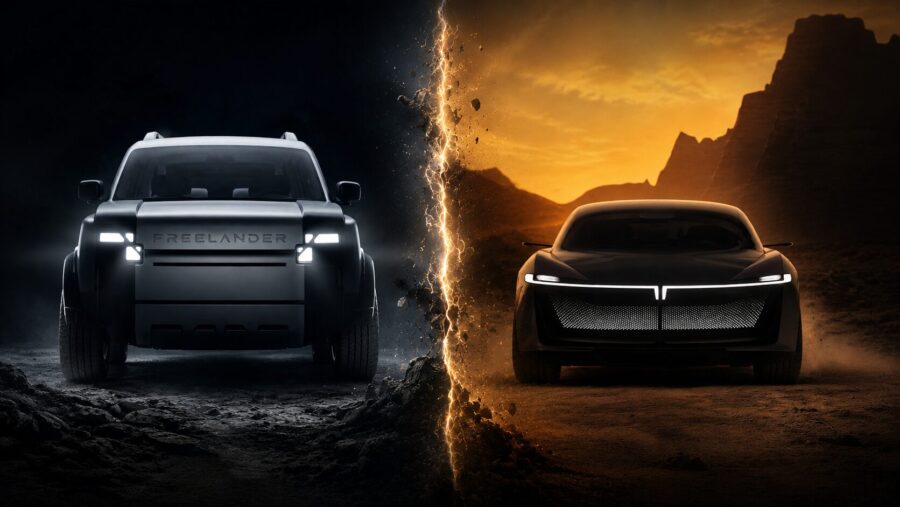
When the ‘Freelander’ nameplate returned earlier this year under the Chery and JLR partnership, it signalled the start of a new chapter built around electric vehicles. Now, that project is set to play a much bigger role. Tata Motors has confirmed that its upcoming Avinya range will use the same platform family that underpins the newly revealed Freelander 8.

This marks an important change for the Avinya programme. Earlier, Tata Motors was expected to build the new EV range on JLR’s EMA architecture. That plan has now been revised, with the company moving to the Chery JLR developed Freelander platform.
The first vehicle to benefit from this decision will be the Avinya X, internally known as P2. It is expected to reach the market in 2027.
Why Tata Changed Its Approach
The original plan involved using JLR’s Electrified Modular Architecture. However, industry sources suggest that the costs associated with adapting that platform became difficult to justify for the expected volumes and pricing of the Avinya range.
The newer platform offers several advantages.
- Faster development timelines
- Better cost efficiency
- Proven EV architecture
- Greater flexibility for future products
By using an existing platform, Tata Motors can spend more effort on software development, localisation, connectivity features and customer experience.
What We Know About The Platform
The architecture comes from the Chery-JLR ecosystem and is related to the platform used by the Freelander 8.
Key details include:
- Support for electric powertrains
- Up to 800V electrical architecture
- Fast charging capability of up to 350 kW
- Modular design for multiple vehicle types
Tata engineers are already working on adapting the platform for Indian requirements. Teams from India, China and the UK are reportedly involved in the development process.
The electronics, software systems and vehicle integration will be tailored specifically for local conditions.
Battery And Range Expectations
Battery plans are still being finalised, but current indications point towards packs ranging between 65 kWh and 80 kWh.
This setup is expected to offer a balance between driving range, vehicle weight and pricing.
While Tata Group’s battery company Agratas remains part of the long-term strategy, initial production models may continue to use support from existing battery suppliers until local capacity expands further.
More Than One Avinya Model Planned
The Avinya X will not be the only product in the lineup.
Tata Motors is also evaluating a larger three-row electric SUV that could arrive after the first model. The company wants Avinya to grow into a dedicated premium EV family rather than remain a single vehicle project.
Engineering prototypes of the Avinya X are expected to appear later this year as development moves into the next phase.
Manufacturing Plans Taking Shape
Production is expected to take place in Tamil Nadu.
The recently opened Tata Passenger Electric Mobility and JLR facility at Panapakkam will play a major role in manufacturing activities.
Industry sources also believe that future collaboration between Tata Motors and JLR could create opportunities for shared sourcing and supplier investments. This could help improve localisation levels over time and strengthen the overall supply chain.
There is another possible benefit as well. Since Chery is expected to supply similar architectures to multiple partners globally, component sharing could increase in the future. This may help reduce costs and improve supplier efficiency for manufacturers operating in India.